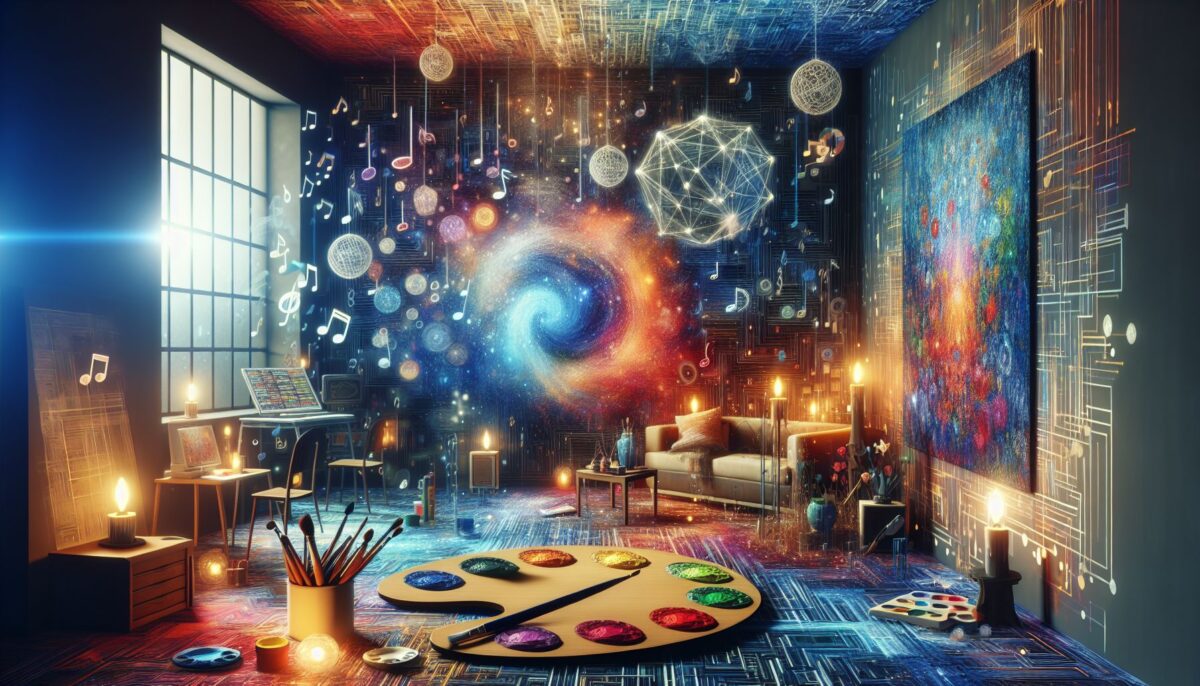
Hey tech enthusiasts, fasten your seatbelts because today we’re diving into an electrifying world where machines and creativity shake hands. That’s right, we’re talking about Artificial Intelligence in creative arts. This is the frontier where Picasso’s brush might just be powered by neural networks, and Beethoven could be brewing symphonies with a sprinkle of algorithmic magic.
Setting the Scene: Is AI the Next Da Vinci?
I remember my first encounter with AI-generated art. Picture staring at a swirling galaxy of colors, all spawned by lines of code. At that moment, I wasn’t just seeing art. I was peeking into the future of creativity. AI isn’t just another tool in the artist’s toolkit—it’s changing how art gets imagined and produced.
From generating music that hits you in the gut to crafting visual pieces that mess with your emotions, AI has become a game-changer. Far from the robotic precision you might expect, AI in arts often spits out unpredictably beautiful results. The question isn’t so much “Can AI create?” but rather “How does AI inspire the human creators who use it?”
The Artistic Side of Algorithms
Redefining Creativity in Music
Let’s talk music. AI has started scoring some real hits. Take OpenAI’s MuseNet, which can compose four-minute pieces with ten different instruments, hopping from pop to symphony like it’s nothing. It’s like having a virtual jam session with Mozart and The Beatles in the same room. Imagine listening to music that adapts to your taste in real time, like a personal DJ that gets you better than your Spotify Discover playlist ever could!
This doesn’t mean game over for musicians. Actually, it’s the opposite. Think of AI as a collaborator, not a competitor. It’s like having a band member who never sleeps, never gets tired, and has endless creative energy. Musicians can grab AI-generated compositions as starting points, then twist and reshape them into something completely their own.
Visual Arts: Pixels Meet Patterns
Artists like Refik Anadol are blurring the lines between art and artificial intelligence, where data sculptures and immersive environments mess with our perceptions. Anadol’s work, for instance, transforms public data into mesmerizing, dynamic installations that feel alive.
AI works as both paintbrush and canvas. Google’s DeepDream and other neural networks dig through noise and data, spitting out surreal imagery that pushes past what human imagination typically produces. Artists who’ve played with these tools often describe it as having a creative conversation with machine intelligence. Each iteration responds back, opening new directions that only become possible with AI in the mix.
The Road Ahead: Challenges and Opportunities
Ethical Questions
But hold your horses—navigating AI creativity isn’t all smooth sailing. One big question: “Is it really art if a machine made it?” Defining ‘creativity’ and ‘authenticity’ in this context opens a Pandora’s box. Yet, isn’t it our job to wrestle with these questions and shape the answers?
And then there’s intellectual property. If an AI creates something, who owns it? The developer? The user? This gray area is a legal and philosophical playground that experts are still figuring out.
The Risk of Playing It Safe
Another issue that really gets me thinking is the risk of over-optimization. Machines excel by learning patterns and optimizing results, which might accidentally lead to predictability or sameness. If AI only draws from past creations, we might end up boxing ourselves in artistically.
That’s why artists using AI need to inject their own unpredictability and emotion into projects. We can’t let the technology kill the raw, untamed spirit that has always defined artistic expression.
Looking Forward: A New Renaissance?
If Leonardo da Vinci could slip on a VR headset or collaborate with a machine artist, he might have painted Mona Lisa in a day. Or perhaps he would have created something entirely beyond what we can imagine today.
AI in creative arts isn’t a fad. It’s a full-blown movement that’s setting up an era where creativity has no bounds, an age of human-machine collaboration that might be our next Renaissance.
As we embrace this techno-creative future, remember that while machines can create, they still look to humans for inspiration—the eternal muse with a knack for pushing boundaries. Happy creating, everyone!
What are your thoughts on this new frontier? I’m excited to hear how you think AI can add color—or sound—to the canvas of the future!
