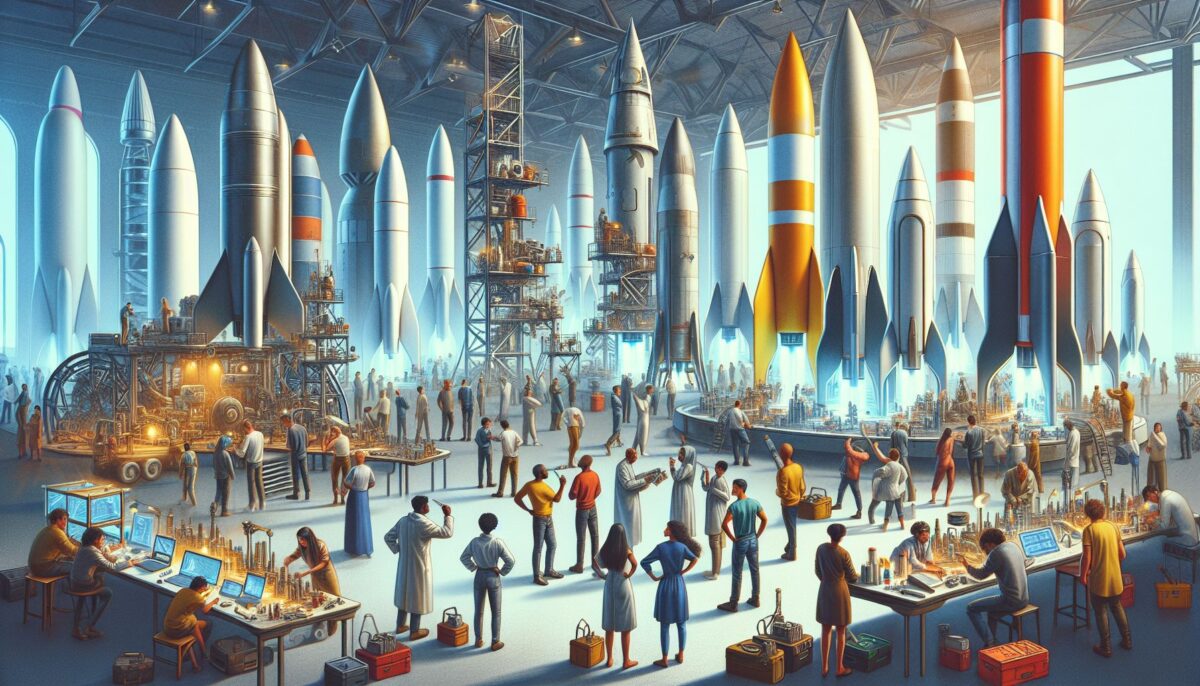
Hey there, fellow tech enthusiasts! 🚀 Have you ever dreamed of leaving the confines of Earth and sailing through the stars? Well, grab your flight suit, because we’re on the brink of making this dream more accessible. Today, we’re diving into the spicy world of DIY space travel. Yeah, you heard me right. The same way folks kicked off with their backyard brewing kits or 3D printers, we’re talking about potentially bringing space travel into a realm where everyday innovators can touch the cosmos.
A New Era: Accessible Rockets
Remember when personal computing was this pie-in-the-sky idea? Now, everyone’s carrying a supercomputer in their pocket. Space travel is going through a similar transformation. Companies like SpaceX have already made headlines by dominating commercial spaceflight. But here’s the thing: a bunch of startup geeks and inventors aren’t satisfied with just watching from the sidelines. They want in, and their garage-based tinkering could change how we see space travel.
Innovators in the Garage: The Power of the Individual
Picture this: an astrophysics grad student spends nights building rocket prototypes in their parent’s basement. Sounds far-fetched? It isn’t. The rise of open-source technology and crowdfunding platforms has enabled the space-obsessed to collaborate and innovate in ways previously unimaginable. Companies like Copenhagen Suborbitals, started by hobbyists, are living proof of the untapped potential in individual innovators taking a shot at the stars.
These passionate groups run on curiosity and the burning desire to push boundaries. A similar ethos to that which drove early tech pioneers like Steve Jobs and Bill Gates applies here, pistons replacing circuit boards. They understand that space isn’t just the final frontier, it’s the collaborative frontier.
Breaking Down the Barriers
Software and open-source platforms have democratized quite a few industries in the past. But space travel? That’s the wild west of all tech frontiers. So, what exactly is helping these garage-space-cowboys thrive? Enter affordable access to technology and information. With platforms like GitHub hosting rocket design and simulations, it’s as if the ultimate space resource library is at your fingertips.
Plus, thanks to advancements in 3D printing, building reliable components isn’t confined to giant factories anymore. A passionate hobbyist with the right tools can manufacture many of the parts needed to build a functioning rocket. This essentially means that the barriers are thinner than a piece of graphene.
The Challenges Ahead: No Gravity, Lots of Grit
Alright, before we shoot off into orbit on a cloud of optimism, let’s get real for a second. The DIY space race isn’t all stardust and dreams. There are some truly massive hurdles to overcome.
Safety and Regulation
First up: safety. Rocket science is, well, rocket science. It’s not inherently forgiving. Even small mistakes can have catastrophic repercussions, context really is key here. Safety protocols must evolve alongside technological innovations to ensure that no one’s DIY journey to the stars turns lethal.
Regulations are another major hurdle. The current legal framework around space travel is as complex as the universe itself. Governments are understandably cautious about letting hobbyists launch potentially hazardous materials into orbit. It’s going to take serious negotiation and trust-building between authorities and DIYers to create a safe, mutually beneficial framework.
Keeping Costs Grounded
While technology is making reaching for the stars cheaper, “cheaper” in space travel still means hefty price tags. Even with cost reductions, hobbyists and startups need significant investment to get off the ground. There’s an ecosystem of venture capitalism slowly growing around space startups, but it’s uncharted territory. Convincing investors that your backyard-built rocket knows its thrust from its gimbal is an uphill battle.
The Sky’s Not the Limit: The Implications
So, what if these challenges are met, or bested? What does a world with affordable space travel look like?
Innovation Everywhere
If the past teaches us anything, democratizing technology leads to innovation proliferation. With more people able to contribute to space technology, we could rapidly accelerate progress in areas like space colonization, sustainable extraterrestrial resources harvesting, and space tourism. The sheer increase in diverse perspectives could generate out-of-this-world (pun intended) solutions to cosmic challenges.
Dreamers to Doers
More than just the technical advantages, affordable space travel could incite a cultural renaissance, with space capturing our collective imagination like never before. People from different walks of life will become starry-eyed creators, artists, and storytellers. They’ll inspire whole generations to look up, ask questions, and go beyond what was previously thought possible.
Final Countdown: Looking to the Horizon
In wrapping up our cosmic chat, let’s get speculative for a second. It’s plausible, if not probable, that in the next few decades, some of us might be sharing our 12th-grade science project on how we launched a probe to Mars. The techno-utopian in me imagines a world where interplanetary travel isn’t only reserved for astronauts and billionaires but for curious humans with stars in their eyes and rocket fuel in their hearts.
We’re living in a thrilling time where space is slowly becoming everyone’s business, literally and metaphorically. Maybe the next pioneering rocket scientist is a kid currently dreamily staring at the night sky, with no inkling of their future. Here’s to reaching for the stars, quite literally.
Until next time, keep your spirit of exploration alive. After all, we might just need a few more curious minds to light the way to interstellar awesomeness! 🌌
