
When Nation-States Decide Your Patch Management Strategy Needs Rethinking
In late 2024, the FBI and CISA confirmed what security researchers had suspected for months: Chinese state-sponsored actors had maintained persistent access to at least nine major US telecommunications carriers, including AT&T and Verizon, for over a year. The operation, attributed to a group tracked as Salt Typhoon, wasn’t some targeted espionage campaign against a single crown jewel. It was methodical, patient, and devastatingly effective at proving that the largest infrastructure operators in North America had gaps so wide you could drive a truck through them. And they did.

What strikes me most isn’t the breach itself. Breaches happen. What gets under my skin is that this wasn’t some zero-day bonanza or a quantum computing breakthrough. The actors exploited vulnerabilities that had patches available for over a year. Cisco disclosed CVE-2023-20198 in IOS XE with a CVSS score of 10.0, the kind of “drop everything and patch now” severity rating that should trigger immediate action. Yet somehow, sophisticated network operators still hadn’t deployed the fix when Salt Typhoon came calling. That’s not a technical problem. That’s an organizational one.
The CISA Advisory That Changed Everything
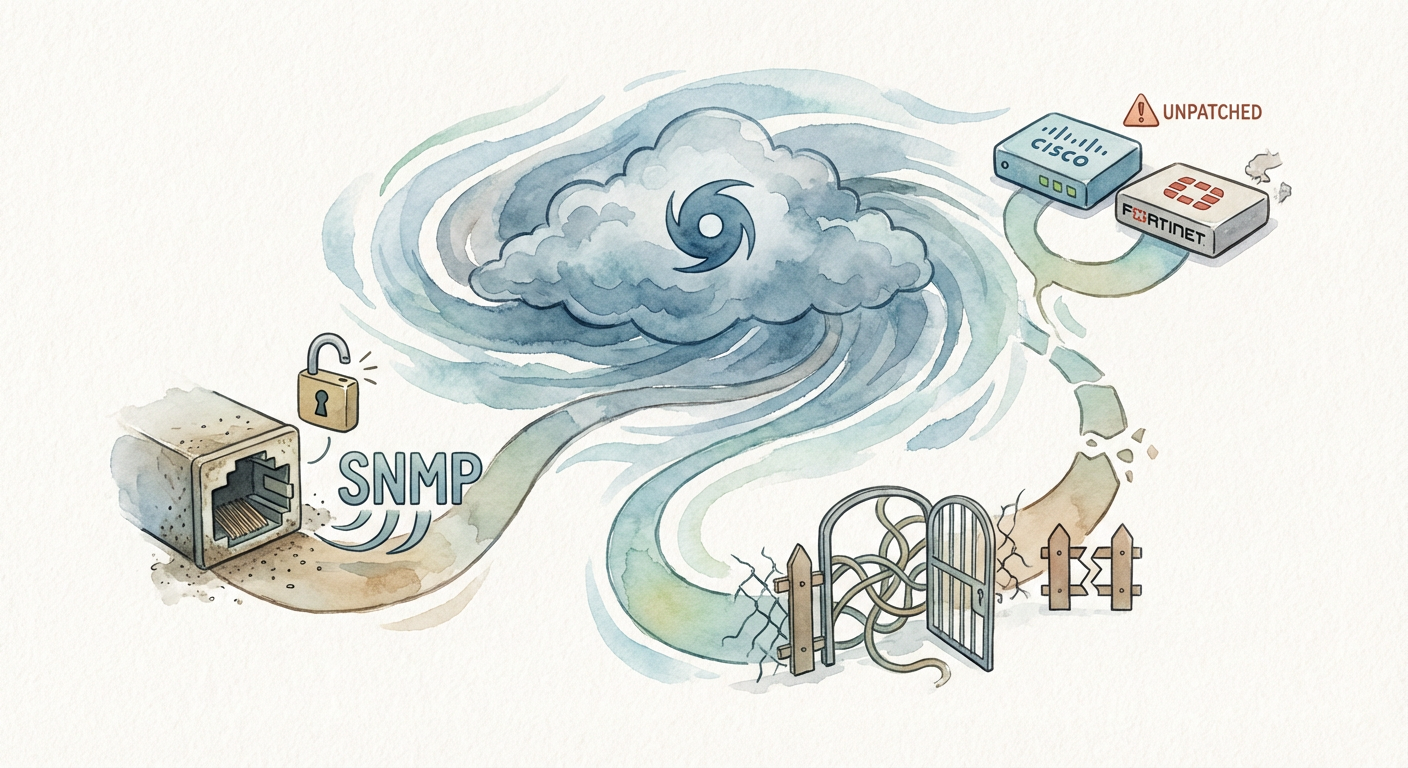
When I read through the CISA Salt Typhoon advisory, I kept finding myself nodding at each attack vector like I was watching a security presentation from 2008. Legacy SNMP configurations. Unpatched edge devices from Cisco and Fortinet. Absent network segmentation. These aren’t exotic exploits. These are the fundamentals that every single network engineer learns about in their first year, yet somehow became the foundation for a nation-state intrusion that touched millions of Americans’ telecommunications.
The SNMP angle particularly illustrates the gap between what we know and what we do. Simple Network Management Protocol was never designed with modern threat models in mind, yet it remains ubiquitous across carrier infrastructure because ripping it out requires coordinated redesign across systems deployed over decades. Add in unpatched equipment sitting at network edges, where operators figure the risk is minimal, and you’ve created a perfect storm. Salt Typhoon didn’t need to be clever. It needed to be patient and methodical, and it was both.
The 2025 Mandate That Caught Everyone’s Attention
Here’s where things get interesting for those of us building systems that touch telecom infrastructure. The FCC issued new cybersecurity rules in January 2025 under Section 105 of the Communications Act, mandating that carriers submit annual cybersecurity risk management plans. This is the first regulatory mandate of its kind, and it’s not window dressing. These plans need to be substantive, detailed, and auditable. The FCC isn’t asking for a checkbox exercise. They’re asking for proof that operators understand their attack surface and have a coherent strategy to reduce it.
What this means for engineers like us is simple: the days of “we’ll patch it eventually” are over. The days of assuming that network segmentation is optional infrastructure are finished. If you’re designing systems that integrate with or depend on telecom carriers, you need to assume that your upstream providers will be held accountable in ways they weren’t twelve months ago. That accountability flows downstream in the form of SLAs, security requirements, and architectural constraints that suddenly matter more than cost per Mbps.
Why Remediation Costs Tell the Real Story
A Mandiant report released in February 2025 found that 73% of affected organizations required full re-architecture of their carrier-grade network management interfaces. Not patches, not incremental improvements, but wholesale replacement of the systems that operators use to manage their networks. Average remediation costs exceeded $47 million per carrier. That’s not a typo. That’s the cost of deferring architectural decisions about segmentation, cryptographic integrity, and access control for years.
I’ve lived through enough infrastructure rewrites to know the difference between “we made a tactical mistake” and “we built a system on assumptions that turned out to be dangerously wrong.” Salt Typhoon falls into the latter category. Those re-architectures aren’t happening because someone found a clever new exploit. They’re happening because operators are finally acknowledging that their network management planes need to be isolated, authenticated, and monitored with the same rigor they apply to customer-facing systems. They’re happening because the regulatory environment now demands it.
What This Means for Your Network Design in 2026
If you’re designing network-adjacent systems now, assume that the security baseline you might have deemed reasonable two years ago is insufficient. Assume that your telecom provider is under new regulatory pressure to validate that every connection to their network management systems is necessary, authenticated, and logged. Assume that “we’ve always done it this way” is no longer an acceptable answer to “why do you need access to that interface?”
The FCC cybersecurity rulemaking proceeding is still evolving, but the trajectory is clear. Carriers will need to demonstrate that they understand their threat landscape, that they’ve inventoried their legacy systems and have timelines for addressing them, and that they’re not just patching reactively. For those of us building systems that integrate with or depend on carriers, that translates into new requirements for authentication mechanisms, audit trails, and network segmentation that we need to plan for now.
The part I find genuinely satisfying about this shift is that good architectural decisions are usually the same ones that satisfy regulatory requirements. Network segmentation isn’t just a compliance checkbox. It’s a fundamental principle that makes systems more resilient, easier to monitor, and less catastrophic when something goes wrong. Proper authentication and cryptographic integrity aren’t bureaucratic overhead. They’re engineering hygiene.
Salt Typhoon exposed the gap between what we said we were doing and what we were actually doing. The regulatory response is forcing that gap to close. If you’re building systems in 2026, that’s actually good news. It means the rules of the game are becoming more explicit, the baseline is being raised, and organizations that invested in doing things right are finally seeing that investment validated. Have you thought about how the new carrier security mandates might affect your architecture? I’d be curious to hear what constraints you’re seeing in your own projects.
