The Proboards38 Blog

Field notes from the operator's chair: postmortems, load tests, migrations, and governance audits for forum-class platforms of 10k+ users.

Archives (page 7 of 12)

The Code Runs the Culture: Why Your Database Schema Matters More Than Your Guidelines

Engineers collaborating around a whiteboard with system diagrams, showing the hidden structure behind online platforms

I’ve spent a good chunk of my career building community platforms, then turning around and ripping them apart to see what actually drove user behavior. I’m not talking about the UI polish—the rounded buttons or the onboarding carousels. I mean the guts: the database schema, the permission logic, the way notification jobs get queued and routed. After a while, a pattern becomes impossible to ignore. A platform’s culture doesn’t sprout from its terms of service. It gets set, like concrete, months before the first person hits the sign-up button.

Community guidelines are reactive. Something blows up, somebody gets harassed, and you add a new rule. Platform architecture, on the other hand, is proactive infrastructure. One tells people what they shouldn’t do after the damage is already done. The other quietly decides what behaviors are even possible, visible, or worth chasing. Pick a threading model for a forum, and you’re not just organizing posts—you’re choreographing how people talk to each other. Choose between a chronological feed and an algorithmic one, and you’re choosing whose voice gets amplified and whose gets muffled before they even speak.

This isn’t abstract theory. This is systems engineering with human consequences. The buttons you surface, the friction you introduce, the metadata you choose to display—those are the real architects of community behavior. Let me walk you through the mechanical side of things.

The Threading Model Is a Power Structure

Flat chronological forums—early phpBB, vBulletin—produce a very specific conversational rhythm. Every reply bumps the thread to the top. The structure rewards persistence, not necessarily quality. One determined user can hog the visible space, not because they’re adding something valuable, but because they simply won’t stop posting. The architecture hands them more surface area by default.

Now put that next to nested comment trees like Reddit’s. A sub-thread can get collapsed, downvoted into invisibility, or ignored outright without shoving the main conversation aside. Parallel discussions can happen simultaneously. Throw in a voting mechanic that sorts by collective judgment instead of recency, and the whole cultural flavor shifts. It’s more fragmented. More meritocratic, in theory. More prone to pile-ons, in practice. But none of that came from a guideline doc. It all fell out of the data model.

Discourse took a hybrid swing at this: flat threads with smart scroll tracking and reply indicators. That little “X replies below” snippet creates an implicit social nudge. It says, “This branch matters,” without forcing full nesting. It cuts down on the fear of getting lost in the noise. The payoff? Longer, more reflective replies than the rapid-fire stuff you see on Reddit. The architecture didn’t ban short comments. It just stopped handing them visibility as a reward.

Close-up of a modular circuit board with glowing connections, representing the logic pathways that define user interaction

Reputation Systems Are Behavioral Compilers

Every platform runs a reputation mechanic, even if nobody calls it that. Old-school forums with visible join dates created quiet seniority hierarchies. Post counts turned sheer volume into status. Then came the karma, the likes, the claps, the “helpful” flags. Each of these is a feedback loop baked into a database column. They don’t just measure contribution—they define what “contribution” even means.

Stack Overflow’s reputation system is the most blunt-force example I’ve seen in production. Upvotes on answers give 10 rep. Upvotes on questions give 5. Accepted answers net 15. A downvote costs you 2. The asymmetry isn’t a bug. The system economically penalizes shallow questions and heavily rewards precise, durable answers. The resulting culture—pedantic, rigorous, occasionally a little hostile to newcomers—wasn’t some fluke of the user base. It was compiled straight from the incentive architecture.

Compare that to a platform that hides all public numbers but quietly tracks engagement for algorithmic sorting. Users feel the difference. Without visible scores, they lean on social signals: who gets responses, who gets quoted, who seems to know what they’re talking about. Removing a leaderboard doesn’t remove competition. It just drives it underground. And covert competition often breeds weirder, more toxic dynamics because there’s no transparent feedback to calibrate against.

I’ve consulted on platforms where a single, almost boring change—replacing exact follower counts with ranges like “1K+”—shifted the tone of interactions within weeks. The little dopamine spike of watching a precise number tick upward got replaced by a slower, fuzzier sense of growth. The engineering change was a conditional in a template. The cultural shift showed up in measurably less spammy follow-for-follow nonsense.

Permission Models and the Default State of Trust

New users show up as untrusted agents. Every platform has to decide what that means at the code level. Can they create threads right away? Upload images? Send direct messages? Ping other users? Each capability is a gate, and the default position of those gates sets the baseline culture.

Platforms that swing all gates open on sign-up—early Twitter is the classic case—optimize for rapid network effects and viral growth. They also optimize for spam, harassment, and coordinated manipulation. The culture turns into a free-fire zone where bad actors get the same footing as genuine contributors. Moderation becomes a never-ending game of whack-a-mole because the architecture never bothered with graduated trust.

Now look at platforms that roll out a trust level system. Discourse’s TL0 to TL4 progression is a state machine wired into the user model. You can’t post images until you’ve spent some time just reading. You can’t flag posts until you’ve shown basic participation. Each unlock is a privilege earned through consistent, positive behavior. The code literally blocks certain classes of abuse until the user has proven they’re not a script or a troll. The guidelines don’t have to plead with people to behave. The system makes bad behavior progressively harder to pull off.

The most underappreciated engineering lever in community design might be the humble rate limiter. A simple throttle on actions per minute doesn’t just stop DDoS attacks—it shapes conversational pace. A forum that allows one post every 30 seconds produces a different quality of discourse than one that allows 10 posts a minute. The slower pace forces users to compose thoughts instead of reacting on impulse. The architecture enforces breathing room that guidelines can only politely request.

Network cables and server racks in a data center, symbolizing the physical infrastructure that governs digital communities

Notification Design Is Attention Economics

Every notification your platform fires off is a claim on someone’s cognitive load. The default settings—what’s on, what’s off, what’s even configurable—act as a de facto editorial policy about what matters. A platform that defaults to emailing you for every reply creates a high-urgency, high-interruption culture. One that defaults to a daily digest creates a reflective, batch-processing rhythm.

Slack’s notification model is a masterclass in architectural influence. Channels are muted by default unless you explicitly join. Mentions punch through do-not-disturb. The system assumes you need protection from noise from the jump, not that you want to hear everything. That one architectural choice shapes workplace culture way more than any “communication guidelines” HR doc ever could. It says: your attention is scarce, and we’ll guard it unless you actively choose the noise.

Forum software that blasts you with a notification for every new thread in a category creates a firehose. Users learn to ignore notifications entirely, which means the genuinely important ones get buried. Smarter architecture uses more targeted strategies—only pinging when there’s a reply to your thread, or when a thread you’ve participated in gets fresh activity. The principle is dead simple: notifications should signal relevance, not just existence.

I’ve watched communities flip overnight when they switched from immediate push notifications to batched summaries. The volume of reactive, low-quality comments dropped because the loop between stimulus and response stretched from seconds to hours. People had time to think. The architecture didn’t tell anyone to be more thoughtful. It just stopped rewarding impulsivity.

Search, Discovery, and the Architecture of Memory

How a platform treats old content decides whether it’s a living archive or an ephemeral stream. Forums with solid search and topic categorization build institutional memory. New users can dig up answers from three years ago, and those old answers keep their value. The culture starts to prize documentation and long-form contribution because the architecture preserves their worth.

Platforms like Discord, with their channel-based, scroll-heavy model, are architecturally hostile to memory. Old conversations become practically inaccessible after a few days unless something gets pinned or manually archived. The culture gets present-focused, relationship-driven, and resistant to deep technical documentation. Neither approach is inherently wrong—but the architectural choice predetermines which type of community will thrive there.

Reddit’s archiving policy, where threads lock after six months, is another architectural decision with deep cultural ripple effects. It stops necroposting, sure, but it also kills the possibility of long-running reference threads. Wikipedia talk pages, by contrast, never lock. The difference is stark: one platform treats conversation as a perishable good, the other as a permanent record. These aren’t guideline choices. They’re database policies, plain and simple.

Frequently Asked Questions

Can’t a toxic culture override even the best platform design?

Absolutely, but design sets the boundaries. A well-architected platform can’t wipe out toxicity, but it can make toxic behavior structurally expensive. Rate limits, trust levels, and transparent moderation logs don’t stop a determined bad actor on a dime—they slow them down, limit their blast radius, and give moderators a window to respond. Bad architecture amplifies toxicity by making it frictionless. Good architecture absorbs it.

How do I know if my platform’s architecture is working against my community goals?

Start by looking for friction mismatches. If your guidelines encourage thoughtful discussion but your interface makes rapid-fire replies the most visible action, your architecture is actively undermining your policy. If you say you want diverse voices but your recommendation engine only surfaces the most popular stuff, you’ve got a design contradiction. Audit your defaults: who gets visibility, who gets notifications, and which actions require the fewest clicks. Those are your real community policies, whether you wrote them down or not.

Is it possible to change a platform’s architecture without alienating existing users?

It’s doable, but you have to treat architectural changes like social contracts. When Reddit introduced nested comments, it was a fundamental shift in conversation structure, but it rolled out gradually and got explained as an improvement. The trick is transparency about why the change is happening and what behavior it’s designed to encourage. Users will stomach structural changes when they understand the intent. They rebel when changes feel arbitrary or when they suspect engagement metrics are the only driver.

What’s the single highest-impact architectural lever for shaping community culture?

The default notification settings. It’s the most direct wire between the platform’s code and the user’s brain. A notification tells a user, “This deserves your attention right now.” If your defaults are noisy, you’re training users to devalue your platform’s interruptions. If they’re precise, you’re building trust that every ping actually matters. Start there. Everything else—threading, reputation, permissions—works on longer timescales. Notifications shape behavior by the hour.

Next time you sit down to draft community guidelines, take a step back and look at your database schema instead. Look at your API rate limits, your caching strategy for feed queries, your user state machine. Those are the documents that actually govern behavior. Words on a policy page matter only after the architecture has already decided what’s possible. Build the culture you want into the code, and the guidelines will almost write themselves.


Why the Best Technical Solutions Account for How Humans Actually Behave

Engineers collaborating around a workstation

We treat community platforms like deterministic machines. We spec servers, optimize database queries, and tune caching layers until response times practically flatline. Then we watch as users ignore the feature we spent three weeks building and hack together their own workflow inside a thread from 2016. The platform works exactly as designed. The humans don’t. That gap isn’t a user failure. It’s a failure of technical imagination.

For years I’ve built and maintained forums, knowledge bases, and internal community tools. Every time, the same pattern kicks in: the most reliable infrastructure becomes irrelevant the moment people find it easier to route around it. The best technical solutions don’t just serve the user story you wrote. They account for the user behavior you didn’t anticipate.

The Spec Is a Lie We Tell Ourselves

A specification document captures intent. It doesn’t capture what happens when a moderator discovers that closing a thread is the fastest way to silence a legitimate argument, or when a power user realizes the search index ignores a metadata field they lean on daily. We design for idealized paths. Humans walk off the trail immediately.

Consider the humble notification system. The engineering requirement says: notify users of replies, mentions, and system alerts. Straightforward. But in practice, users develop notification triage behaviors that look nothing like the linear inbox we imagined. They mentally filter by sender reputation before reading content. They treat the notification count as a proxy for community health. They disable everything when the signal-to-noise ratio dips below a personal threshold we never measured. If the notification system won’t let them filter by thread priority or mute entire categories without four clicks, they simply stop looking. The database stores every alert. The human has already moved on.

This isn’t a UX problem you hand off to a designer after the API gets frozen. It’s an architectural concern. A data model that treats all notifications as equal-weight objects fails to reflect the social weight users assign them. A schema that lacks a perceived_urgency flag or a follower_density metric can’t support the filtering behaviors users need. We optimized for write throughput. We should have optimized for cognitive load.

Social Physics Are Real Constraints

Every community platform has a social physics: unwritten rules about how attention flows, how status accrues, how conflict resolves. These aren’t soft cultural details. They’re structural forces with measurable effects on database load, moderation queue depth, and feature adoption rates.

Take the classic “reputation score.” Implement it as a simple counter, and you create an economy where early adopters stack up unassailable advantage. New users see a leaderboard dominated by accounts from 2018 and conclude the community is closed. They stop posting. Your engagement metrics tank, and you respond by sending re-engagement emails that get marked as spam. The technical fix wasn’t a better email subject line. It was a reputation algorithm that decayed inactive scores or weighted recent contributions more heavily. The math encodes a social value: we want fresh voices to matter. If the code doesn’t bake that in, no amount of community management compensates.

Moderation tooling exposes the same dynamic. Build a flagging system that treats every report as a binary signal, and you hand a weapon to anyone organized enough to coordinate false reports. The system has no way to distinguish between a genuine violation and a harassment campaign because the data model doesn’t capture reporter history, relationship graphs, or timing patterns. The humans exploited a loophole the engineers didn’t know existed. Closing the loophole requires storing context the original spec dismissed as out of scope.

Server rack with blinking lights in a data center

Defaults Are Destiny

Users change settings at vanishingly low rates. The default sort order, the default notification frequency, the default visibility of profile fields—these aren’t preferences waiting to be adjusted. They’re the platform, for the vast majority of people who will never crack open a settings panel.

I’ve watched communities fracture because the default thread sort was “latest activity” instead of “latest post.” The difference seems trivial. In practice, “latest activity” surfaces threads where someone fixed a typo three hours ago, burying the thread where a new member just asked for help. The new member feels ignored and leaves. The engineering team never spots the correlation because they’re monitoring server uptime, not the emotional trajectory of a first-time poster. The fix is one configuration change. The diagnosis required watching real humans use the software with their actual mental models, not the ones we assumed.

Defaults also shape who participates. A registration flow that demands a real name, a bio, and an avatar before allowing a single post filters out everyone who wants to test the waters before committing. A platform that defaults to public visibility for profile fields pushes away people with privacy concerns—not because they have something to hide, but because they’ve learned default-public systems get scraped, indexed, and surfaced in contexts they can’t control. The engineering choice is value-neutral in the codebase. The human consequence is a community that skews toward the over-sharers and excludes the cautious. That skew becomes self-reinforcing as the visible culture normalizes the behavior of those who stayed.

Designing for the Exceptions

Most technical documentation describes the happy path. The unhappy paths—the rage-quit, the sock-puppet detection failure, the database migration that breaks two years of permalinks—are where communities actually live or die. A platform that handles graceful degradation well earns trust. A platform that silently corrupts data or loses content during an edge case burns trust that takes months to rebuild.

Consider the moment a user deletes their account. The spec says: remove personal data, anonymize posts, done. But what happens to threads where that user was the original poster? Do the replies become orphaned? Does the thread lose context that made it valuable to future readers? If the system simply deletes the opening post, it may destroy a knowledge base entry dozens of people bookmarked. The technically correct behavior according to privacy requirements conflicts with the socially correct behavior according to community memory. Resolving that tension requires engineering judgment, not just compliance.

Error messages deserve the same scrutiny. A generic “Something went wrong” after a failed file upload tells the user nothing and trains them to expect failure. A specific message—“Your file exceeds the 10MB limit; try compressing it or splitting into multiple posts”—teaches the user the system’s constraints and lets them self-correct. The difference isn’t just copywriting. It requires the backend to distinguish between file-too-large, unsupported-format, and disk-full errors and surface them distinctly. That’s instrumentation work that never makes the roadmap until someone argues that user trust is a performance metric.

Close-up of hands typing on a laptop keyboard

Testing Against Reality

Unit tests verify that functions return expected outputs. Integration tests verify that services talk to each other. Neither verifies that a human can complete a task without wanting to throw their laptop out a window. That requires a different kind of testing: watching someone use the platform while narrating their confusion.

I’ve run sessions where we asked a new user to find a specific discussion from three months ago. They tried search. It returned 400 results sorted by relevance with no date filtering visible. They tried scrolling through category pages. They gave up after 90 seconds. The database had the post indexed perfectly. The search algorithm was returning mathematically correct results. The human couldn’t bridge the gap between their intent and the query syntax the system expected. The fix wasn’t a better ranking function. It was exposing date-range filters by default and adding a “popular this week” section that required no query at all. The backend work was minimal. The insight came from observing failure.

This kind of testing reveals assumptions invisible to the people who wrote the code. Engineers know the search box supports Boolean operators. Users don’t. Engineers know clicking the thread title goes to the first post and clicking the timestamp goes to the latest. Users click whichever blue text looks promising and get confused when the landing point varies. These aren’t bugs in the traditional sense. They’re design decisions that made perfect sense in a conference room and break down in a living room.

Building for the Long Decay

Community software ages in public. Threads from five years ago still rank in search results. User profiles from people who left still appear in @mention autocomplete. The technical debt of early design choices compounds because the data isn’t just code you can refactor; it’s social history you can’t easily alter without erasing context.

When you change the URL structure, you break every link ever shared. When you merge categories, you invalidate mental maps regulars built over years. When you redesign the post editor, you disrupt muscle memory for the people who produce the most content. Each change is a trade-off between technical improvement and social continuity. The platforms that survive decades are the ones that treat continuity as a first-class requirement, not an afterthought.

This means thinking about data portability early. If your export tool produces a ZIP of JSON files that no one can read without a parser, you haven’t actually solved for user ownership. If your API rate-limits third-party backup tools into unusability, you’ve created lock-in whether you meant to or not. The engineering team may never hear complaints about these failures because the users who care about data portability are the ones who leave silently and take their communities elsewhere.

FAQ

Why do users ignore features we built specifically for them?

Because the feature solves the problem as you defined it, not as they experience it. Users optimize for cognitive ease, not feature completeness. If your new tool demands learning a workflow that clashes with their existing habits, they’ll revert to the old method—even if the old method is objectively worse by engineering metrics. Watch them work. The friction point is rarely where you expect.

How do we measure whether our platform accounts for real human behavior?

Track the metrics that reflect behavioral reality, not just system health. Completion rate for key tasks, time-to-resolution for support queries, and the percentage of new users who return within a week are more telling than page load times. Instrument the paths users actually take, including the workarounds, and treat those workarounds as feature requests written in behavior instead of words.

Is it possible to design for human behavior without endless scope creep?

Yes, if you distinguish between accommodating behavior and indulging every request. Accommodating behavior means recognizing that people will skim, filter, and route around obstacles, and building affordances for those patterns. Indulging requests means adding features that serve one vocal user at the expense of system coherence. The test is whether the change reduces the gap between how the system expects to be used and how it’s actually used across the whole user base.

The server will keep running whether or not the humans feel served by it. But a platform that runs perfectly and serves no one is just an expensive space heater. The engineering worth doing is the kind that understands the hardware, the software, and the messy, adaptive, shortcut-seeking people who have to live inside both.

The Problem With Thinking That Infrastructure Is Neutral

Concrete bridge piers casting long shadows in early morning light, showing engineered repetition
Infrastructure shapes movement long before we notice its constraints.

Most engineering conversations carry a quiet assumption. A road, a data center, a water treatment plant, a fiber backhaul—those are just technical objects. Bits. Vehicles. Cubic meters per second. They have spec sheets. They obey physics. And because they obey physics, they must not have politics. That assumption isn’t merely wrong. It’s dangerous. It lets everyone off the hook. Nobody has to ask who pays, who benefits, and who gets locked out the moment the concrete cures.

A few years ago, I walked a site in a mid-sized American city. The project was a stormwater retrofit meant to stop chronic flooding across three neighborhoods. The engineering was clean. Calibrated hydrology models. Bypass channels sized for the 100-year storm plus a climate buffer. On paper, the whole thing radiated neutrality: water enters, water leaves, basements stay dry. But the routing plan drove the new culverts straight through two working-class neighborhoods and dodged a wealthier one by maybe three blocks. The models didn’t flag that. Why would they? Models don’t read ZIP codes. The outcome wasn’t neutral at all. Construction chaos, easement takings, the drone of long-term maintenance—it all landed on people with fewer ways to absorb the hit. Hydraulically, the infrastructure did exactly what it was designed to do. Socially, it shuffled harm downhill.

This is the knot at the center of it all. Infrastructure systems are priorities poured into physical form. When we sketch a network, we make choices about topology, capacity, redundancy, and who controls access. Those choices carry baked-in assumptions about who counts and what kind of failure we’re willing to tolerate. A fiber ring that links five corporate campuses but swings wide around a public school district isn’t some neutral artifact of least-cost routing. It’s a statement. A bus rapid transit line that blasts express through a low-income corridor without local stops isn’t just a puzzle for the ops research folks. It’s a verdict on whose time is worth something.

Infrastructure Inherits Intent

Every piece of infrastructure inherits its builders’ intent, whether that intent ever got written down or not. The U.S. interstate highway system is the worn-out textbook example for good reason. Engineers will say it was designed for national defense and economic connectivity. Historians will add that its urban segments were frequently routed through Black and immigrant neighborhoods, bulldozing housing stock and slicing commercial districts in half. The asphalt didn’t pick that path. People did. The technical standards—lane width, curve radius, overpass clearance—were drafted to accommodate military convoys; the demolition maps were drawn by city planners who saw certain communities as obstacles. Both things are true at the same time. The steel and earth carry both the engineering logic and the social logic.

You see the same pattern in digital infrastructure. Internet exchange points, submarine cable landing stations, cloud regions. They don’t scatter randomly across the map. They clump where capital pools and regulatory climates feel predictable. A content delivery network’s edge node placement is a map of economic power, not some neutral reflection of population density. When a user in West Africa has their request routed through a data center in Marseille because no local peering point exists, that’s not a technical inevitability. It’s the residue of investment decisions made in boardrooms that never sent an engineer to Accra. The latency shows up in milliseconds. The exclusion shows up in economic opportunities that never materialize.

Rows of server racks with blinking lights in a climate-controlled data center corridor
Data centers are physical geography, not clouds. Location is a choice with consequences.

The Cost of Abstraction

Engineers love abstraction. It’s how we solve hairy problems—strip away the detail. We model a network as a graph, a watershed as a differential equation, a power grid as nodes and edges with impedance values. Abstraction is genuinely powerful. It’s also morally slippery when we forget what got stripped. In the graph, a node is just a node. Out in the world, one node is a hospital with backup generators; another is a public housing complex with no fallback. Treat them identically, and the load-shedding algorithm will disconnect them with equal probability. Mathematically fair. Not remotely just.

I’ve watched this unfold in microgrid planning. A sharp engineering team designed a community solar-plus-storage system for a rural county. The optimization algorithm minimized total cost of energy across all connected households. That meant it prioritized battery discharge to homes that pulled more power during peak pricing windows. Those homes tended to be larger, more affluent, already kitted out with efficient appliances. Lower-income households—using less energy overall but far more vulnerable to outages—got lower priority in the dispatch logic. The algorithm was correct on its own terms. The outcome was regressive. The engineers hadn’t asked the basic question: “What’s this system actually for? Resilience for the people who need it most, or cost optimization for the average user?” Until that question sits out in the open, the default is always the latter.

Standards Are Not Innocent

Technical standards are another place where neutrality claims fall apart under a hard look. A communication protocol, a building code, a voltage standard—they look like pure engineering products. But standards get written by committees. Committees have membership. Membership costs money: fees, travel, institutional backing. The outfits that can afford to send engineers to IEEE working groups or IETF meetings aren’t some random cross-section of the world’s stakeholders. They’re large corporations, wealthy governments, well-funded research shops. The resulting standards reflect their worries. If a smart grid interoperability standard assumes always-on broadband, it quietly excludes communities where broadband is patchy. If a structural engineering code assumes a fifty-year design life without a thought for adaptive reuse, it encodes a bias toward demolition and replacement over incremental repair.

Take something as mundane as sidewalk dimensions. AASHTO guidelines hand out minimum widths based on pedestrian flow rates pulled from commuter studies in dense downtowns. Apply those same minimums to a rural town with a lot of older residents, and you get a sidewalk that can’t fit two people walking side by side or a mobility scooter without a squeeze. The standard wasn’t designed to exclude. It was designed without imagining those users at all. That’s the quiet violence of pretending something is neutral: it treats the unimagined as irrelevant.

An empty sidewalk alongside a busy road, with cracked pavement and no pedestrian in sight
Sidewalk geometry is a design choice that determines who can move safely through public space.

Maintenance as a Political Act

If design encodes priorities, maintenance reveals them. Infrastructure decays. Asphalt cracks, pipes corrode, switchgear wears out. The decision to repair, defer, or abandon is always a resource allocation decision. When a water utility replaces lead service lines on a schedule that favors neighborhoods with higher property values, that’s not a technical optimization. It’s a political choice routed through a work order system. When a transit agency runs buses on 20-minute headways in a business district and 60-minute headways in an outlying neighborhood, the maintenance and operations budget is announcing whose time matters.

I worked on a project rehabbing a wastewater treatment plant in a shrinking industrial city. The plant served a population that had dropped 40% over three decades. Per-capita cost of maintaining full treatment capacity kept climbing steeply. The engineering consultant recommended consolidating treatment at a regional facility and decommissioning the local plant. Financially, it checked out. But the local plant was also a significant employer, and its lab was the only water-quality testing resource within a hundred miles. Shutting it down would kill jobs and leave downstream communities with no independent monitoring capacity. The financial model tallied the first-order costs. It didn’t count the hollowing out of local technical know-how. A neutral spreadsheet said close it. A community infrastructure analysis said something a lot messier.

Community Infrastructure Is Engineered, Not Given

There’s a habit of talking about “community infrastructure” like it’s a natural feature—a watershed, something that just exists and needs protecting. That framing runs backward. Community infrastructure gets built. Built by people making decisions about zoning, spectrum allocation, bus routes, where to bury fiber and where to lash it to poles. Every one of those decisions is an engineering decision with human stakes. The question isn’t whether infrastructure has social effects. It always does. The question is whether we’re deliberate about understanding and shaping those effects, or whether we let them fall out as byproducts of an optimization function we never bothered to inspect.

I’ve seen community networks that get this right. In one rural cooperative, the members designed their own fiber-to-the-home topology. They picked a ring architecture with distributed peering because they wanted resilience for telehealth during storms, not because it was the cheapest path. They explicitly valued clinic uptime over bandwidth for streaming video. The engineering reflected that. It wasn’t neutral. It was intentional. And because it was intentional, it could be debated, adjusted, and held accountable. That’s the alternative to neutrality: not bias, but declared purpose.

What Engineers Owe

None of this is a call for engineers to quit engineering and become sociologists. It’s an argument that engineering already contains sociology, whether we admit it or not. The load forecast, the traffic model, the coverage map—each one bakes in assumptions about human behavior and human value. When we refuse to examine those assumptions, we default to whatever values are already cooked into our tools and institutional incentives. Usually, that means optimizing for cost, speed, or throughput as defined by the client writing the check. Those aren’t the only values that count.

What we owe is basic professional honesty about what our designs do and to whom. That means writing a scope of work that asks distributional questions. Who benefits? Who carries the risk? Whose baseline gets better, and whose stays the same? It means treating stakeholder engagement not as a PR checkbox but as a source of real design requirements. If a community says reliability during extreme heat is their top worry, that constraint is as real as a seismic zone factor. It means documenting the tradeoffs we make, so someone a decade later can trace why one neighborhood floods while another stays dry.

This is harder than it sounds. It eats time that contracts rarely budget for. It demands language skills engineering curricula don’t teach. And it requires a willingness to sit with discomfort, to accept that a technically elegant solution can still be lousy when measured against human outcomes. But the alternative—pretending infrastructure is neutral—is a form of professional negligence. It’s designing blind and then walking away from the consequences.

FAQ

Why do engineers often claim infrastructure is neutral?
Because the tools of engineering—mathematics, physics, materials science—are themselves universal. It’s easy to confuse the tool with the thing built. Most engineering education trains you to solve well-defined problems with clear constraints, not to interrogate who defined the problem or what got left out. The neutrality claim is often a shield against complexity that feels unscientific.

Can infrastructure ever be made truly fair?
Fairness isn’t a single property you can spec out. Different communities carry different definitions: equal shares, priority for the most vulnerable, return on investment. There’s no universal formula. The best we can do is make the value judgments explicit so they can be contested and revised. Fairness grows out of process, not a specification sheet.

What does a non-neutral design process look like in practice?
It starts with asking “Who is this for?” and writing the answer straight into the design basis. It includes distributional analysis: mapping who gains and who loses across several dimensions, not just cost. It means bringing affected communities into defining what success looks like. And it requires post-occupancy evaluation that checks whether the design did what it claimed, not just whether it hit the technical spec.

How do you push back when a client demands a purely cost-optimized design?
With data. Show the lifecycle costs of ignoring equity: maintenance backlogs, regulatory fines, community opposition, reputational damage. But also show the engineering alternatives. Lay out a few options with different distributional outcomes, honestly costed. Clients often default to narrow optimization because nobody has shown them a feasible alternative. It’s our job to put one on the table.

How Distributed Communities Sustain Themselves When Platforms Do Not Care

The Platform Is Not Your Friend

Every few months, another platform decision lands like a controlled demolition. Reddit walls off third-party access. Discord shifts pricing tiers with no community consultation. Slack retires shared channels. The announcements use language about “improving experience” or “long-term sustainability,” but the engineering reality is simpler: the community that built value on your infrastructure is now a liability on your balance sheet.

I have watched this pattern repeat across two decades of distributed systems work. The community invests thousands of person-hours creating documentation, moderating discussions, building tooling, generating content that makes the platform searchable and valuable. The platform extracts that value, then discards the community when the economics shift. This is not a failure of empathy. It is a failure of architecture. When your community’s entire operational stack—identity, history, communication channels, governance—lives on someone else’s infrastructure, you are running production systems on a platform that has no contractual obligation to keep them running.

Network cables and server infrastructure representing platform dependency

Understanding the Dependency Graph

When a platform makes a hostile change, the immediate reaction is outrage. The productive response is to map your dependency graph. What specific capabilities does the platform currently provide?

Most communities discover they depend on the platform for at least six distinct functions:

  • Identity and authentication — who members are, how they prove it
  • Persistent communication — searchable history, thread continuity
  • Discovery and routing — how new members find the community
  • Access control — who can read, write, moderate
  • Content storage — the actual posts, files, media
  • Event notification — pushing updates to relevant members

Each of these is an engineering problem with known solutions. The challenge is that communities rarely recognize them as engineering problems until the platform forces the issue. By then, the migration deadline has already been set by the platform’s roadmap, not the community’s capacity.

Why Platform Incentives Always Diverge

Platform companies optimize for metrics their investors care about: daily active users, revenue per user, time-on-platform. A mature, stable community that has already grown does not serve those metrics as well as a new user acquisition would. This is why platform features consistently cater to onboarding rather than retention. The Electronic Frontier Foundation documented this exact dynamic during the Reddit API pricing changes: the infrastructure communities relied on was repurposed for revenue extraction with minimal notice.

The lesson is structural. A for-profit platform will always eventually prioritize revenue over community stability. This is not cynicism. It is reading the incentive structure correctly.

Building Redundant Infrastructure

The communities that survive platform hostility are the ones that started building redundant infrastructure before the crisis. Not as a replacement, but as a parallel system that can absorb load when the primary fails.

Consider the architecture: your community needs a communication layer that no single company controls. This means running your own Matrix server, Discourse instance, or mailing list. It means maintaining a Domain Name System record that points to infrastructure you control. It means having a backup identity system, even if it is as simple as a spreadsheet of member PGP keys.

Distributed network nodes showing community resilience architecture

The Cost Question

Someone will object: running infrastructure costs money. True. But so does rebuilding your community from scratch every three years when a platform decides your use case no longer fits their product vision. The cost calculus is not “free platform versus paid hosting.” It is “predictable monthly hosting bill versus unpredictable existential risk.”

A small Discourse instance runs $100/month. A Matrix homeserver for a mid-size community runs $20-50/month. DNS registration is $12/year. The total cost of community sovereignty is typically less than what organizations spend on coffee. The real cost is operational attention—someone has to maintain the systems, apply security patches, manage backups. This is where community engineering becomes a human commitment, not just a financial one.

Governance as Load Balancing

Technical redundancy means nothing if the community fractures when a decision needs to be made. Governance in distributed communities serves the same function as load balancing in distributed systems: it prevents any single point of failure from taking down the whole network.

The most resilient communities I have worked with share three governance characteristics:

Distributed authority. No single person holds the keys to all infrastructure. Domain registrar credentials, hosting access, and payment methods are split across at least three trusted members. If any one person disappears—or turns hostile—the community can continue operating.

Documented processes. Every operational procedure is written down, from “how to add a new moderator” to “how to migrate the database.” This documentation lives in a version-controlled repository, not in one person’s terminal history. When the primary maintainer stepped away from the Apache Software Foundation, their governance documentation meant someone else could pick up the work within days, not months.

Transparent decision-making. Major decisions are discussed in public channels, voted on through defined processes, and recorded for future reference. This is not about democracy for its own sake. It is about creating a decision log that new contributors can read to understand why things work the way they do.

Knowledge Preservation Under Hostile Conditions

When a platform stops caring, the first thing at risk is institutional memory. Forum threads become inaccessible. Wiki edits get lost in migration. Hard-won technical discussions vanish because someone decided the storage tier was too expensive.

Knowledge preservation is a backup problem with human stakes. The standard approach:

  1. Export early and often. Most platforms have an export function. Use it on a schedule. Store the exports in multiple locations—your own server, a cloud bucket you control, a local backup on someone’s workstation.
  2. Convert to open formats. HTML, Markdown, plain text. Proprietary database dumps are not preservation. They are a migration task waiting to happen.
  3. Index everything. Static site generators like Hugo or Jekyll can turn exported content into a searchable archive that runs on any cheap hosting. This gives you a read-only snapshot that survives even if the original platform disappears tomorrow.
  4. Distribute the archive. Share copies with trusted community members. A backup that exists in one location is a backup that will eventually be lost.

Data center infrastructure representing community-controlled systems

Communication Redundancy as Resilience Engineering

A community that communicates through a single channel has a single point of failure. When that channel degrades—whether through platform policy, technical outage, or deliberate restriction—the community disappears.

Resilient communities maintain overlapping communication channels with different failure modes. A Discord server and a mailing list and a Matrix room. A subreddit and a Discourse forum and an IRC channel. The specific technologies matter less than the architectural principle: no single platform outage or policy change can cut off all communication.

This redundancy has a cost in attention. Members must monitor multiple channels. Conversations fragment across platforms. The community’s collective attention is the scarce resource, and splitting it across channels reduces the density of interaction on any single one.

The engineering tradeoff is real: redundancy reduces catastrophic risk but increases operational friction. The communities that navigate this successfully accept the friction and design around it. They designate one channel as primary, others as fallback. They cross-post important announcements. They maintain a single canonical calendar and link repository that all channels reference.

The Migration Playbook

When the platform finally forces your hand, you need a migration plan that has already been tested. Not a theoretical plan. A tested one.

The playbook looks like this:

  1. Announce the timeline. Give members a clear schedule. “We are moving in 90 days. Here is what will happen on each date.”
  2. Open the new platform early. Get the replacement running at least 60 days before the old one becomes unusable. Members need time to create accounts, test access, and discover the interface.
  3. Set up redirect links. Post persistent links from the old platform pointing to the new one. Do this before the old platform can block such links.
  4. Import the archive. Bring as much history as possible. A community without its history is a group of strangers.
  5. Run both in parallel. During the transition period, maintain both platforms. Respond on both. Make the new one the canonical source, but do not abandon members who have not migrated yet.
  6. Close the old platform cleanly. Post a final message explaining the move. Leave it readable if possible. Some members will only surface months later.

The Long-Term Architecture

Community infrastructure is engineering, and engineering is about understanding constraints. The constraint here is that platforms will not prioritize your community’s survival. Accept this constraint. Design for it.

The long-term architecture for community sustainability is the same pattern that works for any distributed system: minimize single points of failure, maintain redundant communication paths, document operational procedures, and ensure that no single vendor controls your data, your identity, or your ability to communicate.

This is not a radical proposal. It is standard systems engineering applied to social infrastructure. The only difference is that the systems we are maintaining are made of people, not packets. The stakes are higher. The engineering discipline should match those stakes.

FAQ

How do we convince community members to move to self-hosted infrastructure when the existing platform still works?

You do not convince them by arguing about principles. You convince them by making the self-hosted option better for their actual use cases. Run the new infrastructure in parallel. Make it faster, more reliable, or more feature-rich than the platform alternative. People adopt tools that solve their problems, not tools that align with ideological positions. Once they are using your infrastructure because it works better, the migration becomes a non-event.

What if our community lacks the technical expertise to run its own infrastructure?

Every community has at least one person who can learn. The technical requirements for running a Discourse instance or a Matrix server are not significantly different from maintaining a complex Minecraft server or configuring a home network. If your community has people who can moderate discussions or organize events, you have people who can learn basic sysadmin tasks. The documentation exists. The communities that fail are not the ones lacking expertise—they are the ones that refuse to develop it.

Is it realistic to expect small communities to maintain their own infrastructure indefinitely?

Small communities have survived on volunteer-maintained infrastructure for decades. Fidonet, early Usenet, countless mailing lists, BBS networks—all of these ran on small-community infrastructure maintained by people who treated it as a contribution to something they valued. The question is not whether it is realistic. The question is whether your community treats infrastructure maintenance as real work that deserves recognition. If you do, you will find people willing to do it. If you treat it as invisible labor, you will always be dependent on platforms that exploit that invisibility.

How Distributed Communities Sustain Themselves When Platforms Do Not Care

Collaborative team working on infrastructure

Platform companies make decisions based on metrics that have nothing to do with the communities living on their infrastructure. When a social network pivots to video, when a forum software shuts down its free tier, when a messaging app changes its API terms, the communities that built themselves on that ground face a question nobody asked them: stay and adapt, or leave and rebuild.

The communities that survive these events are not the loudest or the largest. They are the ones that treated their own continuity as an engineering problem worth solving before the platform gave them reason to.

The Dependency Problem

Every community that forms on a hosted platform develops dependencies. Some are obvious: the URL, the user accounts, the post history. Others take longer to recognize: the search indexing, the notification system, the embed handling, the rate limits that happen to match the community’s conversation cadence. When a platform changes or withdraws these features, the community discovers how many of its workflows were built on assumptions it never validated.

This is not a failure of the community. It is a structural condition of hosted software. The platform owns the infrastructure, which means it owns the constraints. Communities that thrive under one set of constraints may collapse under another, and the platform has no obligation to care either way.

What Platform Neglect Actually Looks Like

Platform neglect is rarely a single dramatic event. It is more often a slow degradation: features that stop receiving updates, support tickets that close without resolution, documentation that drifts out of date, API endpoints that silently change behavior. For the platform, these are low-priority items on a backlog. For the community, they are signal flares indicating that the ground is shifting.

The communities that notice these signals early and respond to them as infrastructure problems rather than social grievances tend to survive. The ones that treat platform neglect as a customer service issue, waiting for it to be fixed, tend not to.

Redundancy as Community Practice

Network cables and server infrastructure

In systems engineering, redundancy exists so that the failure of one component does not bring down the whole system. The same principle applies to community infrastructure, though the components look different.

A community with a single communication channel, a single archive location, and a single identity system has no redundancy. If the platform hosting any of these fails or becomes hostile, the community has no fallback. Building redundancy means establishing parallel systems before they are needed, not during a crisis.

Communication Layer Redundancy

The most common form of community redundancy is the backup channel. A Discord community maintains a mailing list. A Reddit community operates a wiki on independent hosting. A forum keeps an IRC channel active. These parallel channels serve different purposes during normal operation, but they become critical infrastructure when the primary platform becomes unreliable.

The challenge with communication redundancy is not technical. It is social. People congregate where the activity is. Maintaining a backup channel means encouraging enough regular use that the channel remains functional, without fragmenting the community’s attention so badly that no single location has critical mass.

Successful communities handle this by giving the backup channel a distinct but complementary purpose. The mailing list handles announcements and long-form discussion. The IRC channel handles real-time coordination. The wiki handles reference material. When the primary platform fails, users already know where to go and what to expect there.

Data and Archive Redundancy

Community archives are often the first casualty of platform neglect. When a forum shuts down, years of accumulated knowledge become inaccessible. Communities that maintain independent archives, whether through regular exports, API-based backups, or community-maintained mirrors, preserve their institutional memory.

The technical implementation matters less than the habit. A weekly export to a community-controlled repository, even if nobody reads it, ensures that the archive exists when needed. The community that waits until the platform announces a shutdown to start archiving will almost certainly lose data.

Migration as an Engineering Discipline

When a community decides to leave a platform, the migration process reveals how well the community has maintained its independent infrastructure. Migrations fail for predictable reasons: identity fragmentation, data loss, search-engine invisibility, and social fragmentation.

Identity fragmentation occurs when users cannot carry their reputation or history from the old platform to the new one. Community-managed identity systems, such as verified profiles on independent domains or reputation systems backed by cryptographic proof, can mitigate this. The simpler approach is often just maintaining a migration thread where users claim their old identities, but this requires social trust that must be built before the migration.

Data loss is the most visible failure mode. If the community has maintained archives, this is solvable. If it has not, the migration will happen with gaps. These gaps are not just missing posts. They are missing context, missing decisions, missing the record of why the community does things the way it does.

Search-engine invisibility is a longer-term problem. A community that migrates from an established platform to a new domain will lose years of search indexing. There is no quick fix for this. The best mitigation is to maintain enough independent web presence, on community-controlled domains, that search engines have something to index beyond the platform’s domain.

Self-Hosting and Federation

People collaborating on technical infrastructure

Some communities respond to platform neglect by running their own infrastructure. This is a significant commitment, but it eliminates the dependency on platform decisions. Self-hosted forums, chat servers, and wikis give the community full control over their technical stack.

Federated systems offer a middle ground. Platforms using protocols like ActivityPub or Matrix allow communities to maintain their own servers while interoperating with a broader network. The community gains control over its infrastructure while retaining the network effects that make large platforms valuable.

Both approaches require technical capacity within the community. Someone needs to manage the server, apply updates, moderate spam, and handle outages. Communities that distribute this responsibility across multiple members are more resilient than those depending on a single volunteer. If the single volunteer leaves, the infrastructure goes with them.

The Economics of Self-Sustenance

Running independent infrastructure costs money. Server hosting, domain registration, and the labor of maintenance all require resources. Communities that survive long-term have either found sustainable funding models or have kept their infrastructure costs low enough that informal contributions cover them.

Patreon, OpenCollective, and similar platforms provide mechanisms for recurring community funding. Some communities maintain their own payment infrastructure. Others rely on institutional sponsors, such as companies that benefit from the community’s existence. Each model has tradeoffs in terms of accountability, sustainability, and independence.

The communities that struggle most are those that have grown accustomed to free platform hosting and then discover that equivalent self-hosted infrastructure costs real money. The transition from free to funded is a social challenge as much as a financial one.

Continuity Planning

The uncomfortable truth about distributed communities is that they are always one platform decision away from disruption. Continuity planning means accepting this reality and building systems that can adapt.

Effective continuity planning includes maintaining archives on independent infrastructure, establishing backup communication channels with active user bases, documenting migration procedures before they are needed, distributing technical knowledge across multiple community members, and securing sustainable funding for infrastructure costs.

None of these steps require a platform’s permission. They do require sustained effort from community members who may never see the direct benefit of their work, because the crises they are preparing for may never arrive. This is the fundamental challenge of community infrastructure: the work is invisible when it succeeds and glaringly necessary when it fails.

The communities that sustain themselves are those that have made this work routine. They archive because archiving is what the community does, not because the platform is shutting down. They maintain backup channels because redundancy is part of their operating practice, not because they received a warning. They plan migrations because they understand that platforms change, not because they are already looking for an exit.

Platform companies will continue to make decisions based on their own metrics and timelines. Communities that treat their own continuity as an engineering problem, rather than a loyalty problem or a customer-service problem, will continue to survive those decisions. The rest will not.

FAQ

How does a community know when a platform is neglecting it?

Look for patterns rather than single incidents. Support tickets that go unresolved, features that degrade without acknowledgment, API changes that break community workflows without migration paths, and documentation that stops being updated are all indicators. A single delayed response is not neglect. A sustained pattern of inattention on issues the community cares about is.

What is the minimum viable redundancy for a community?

At minimum, a community needs a way to reach its members if the primary platform goes down, and a way to preserve its accumulated knowledge. This means at least one independent communication channel with enough active users that announcements can propagate, and at least one regularly updated archive on infrastructure the community controls. Anything less is a single point of failure.

Is self-hosting always better than using a platform?

No. Self-hosting gives the community control over its infrastructure, but it also gives the community full responsibility for maintenance, security, and moderation. Many communities lack the technical capacity or the volunteer labor to sustain this. Federated systems can provide a reasonable compromise, offering community control with reduced operational burden. The right choice depends on the community’s technical resources, its size, and how much it values independence over convenience.

Why the Internet Keeps Breaking the Same Ways and Nobody Seems to Learn

On June 8, 2021, a configuration change at Fastly took down dozens of major websites for roughly an hour. On October 4, 2021, a faulty BGP route leak at Facebook made their entire autonomous system disappear from the internet. On December 7, 2021, an AWS us-east-1 outage cascaded into failures across services that thousands of businesses depended on. And on July 18, 2024, a CrowdStrike configuration update bricked millions of Windows machines worldwide.

If you read the post-incident reports, you will notice something unsettling: the root causes sound almost identical to incidents from 2019, 2017, 2015, and earlier. BGP leaks. DNS misconfigurations. Expired TLS certificates. Cascading failures from single-region dependencies. These are not novel failure modes. They are well-documented, well-understood, and eminently preventable. Yet they keep happening.

Server racks in a data center

The Same Four Failures, Again and Again

Internet infrastructure breaks in predictable ways. If you read outage reports across the last decade, you can sort almost every major incident into a small handful of categories.

BGP Route Leaks and Hijacks

Border Gateway Protocol is the routing protocol that holds the internet together. It works on trust: if an autonomous system announces a route, other systems accept it. When an ISP accidentally announces prefixes it should not—whether through misconfiguration or software bugs—traffic gets routed into black holes. This happened in 2008 when Pakistan Telecom tried to block YouTube domestically and instead made YouTube unreachable globally. It happened again in 2019 when a small ISP in Pennsylvania accidentally announced large chunks of the internet’s address space, diverting traffic through networks that could not handle it. And it keeps happening. BGPStream detects route leaks and hijacks on a near-daily basis. Most are small enough to avoid headlines. Some are not.

DNS Misconfigurations and Outages

DNS is the phonebook of the internet, and it breaks in boring, repetitive ways. Someone deletes a record. Someone forgets to renew a domain. Someone deploys a configuration file with a syntax error that propagates to all resolvers. In 2023, a Microsoft DNS misconfiguration took down multiple Azure services for hours. The cause was, at its core, the same class of error that has broken DNS for two decades: a human made a change, there was no adequate validation, and the change was pushed to production without sufficient rollback capability.

Network cables connected to switches

Expired Certificates

TLS certificates expire. This is not a surprise. The expiration date is embedded in the certificate itself. Yet organizations with engineering teams numbering in the thousands still let certificates expire, taking down services. In 2020, an expired certificate at CenturyLink took down a large portion of internet traffic for hours. Verizon had the same problem in 2019. These are companies whose core business is network infrastructure. If they cannot manage certificate rotation, who can?

Single-Region and Single-Vendor Dependencies

Every significant cloud provider outage reveals how many services depend on a single region—usually us-east-1—and fall over when that region has problems. Multi-region architectures are not a secret. They are covered in documentation, conference talks, and blog posts from every major provider. But building multi-region failover is hard and expensive, so many organizations treat single-region deployment as acceptable risk right up until it breaks.

Why Nobody Learns

The failure modes are known. The mitigations are known. So why do we keep repeating the same mistakes?

Institutional Amnesia

Engineering teams have high turnover. When the people who lived through the last outage leave, they take the institutional memory with them. The post-incident document survives, but the visceral understanding of what went wrong and why it mattered does not. New engineers arrive, see a system that has been running fine for two years, and assume it is solid. They do not know that it is solid only because of a fragile manual process that someone set up after the last incident and that nobody has maintained since.

This is not a knowledge management problem. It is a cultural problem. Organizations that treat incident reports as checkbox exercises rather than genuine learning opportunities will keep having the same incidents. The report gets filed, the remediation items get assigned, and then everyone gets busy and half the action items get dropped. Six months later, the same class of failure recurs.

Misaligned Incentives

Reliability work is invisible when it succeeds. Nobody gets promoted because a BGP route leak did not happen. Nobody gets a bonus because their DNS configuration validated correctly before deployment. The work that prevents outages is slow, unglamorous, and difficult to justify in quarterly planning. Shipping features and hitting launch dates are visible. Hardening infrastructure against edge cases is not.

This creates a predictable cycle. An outage happens. Leadership demands to know why this was allowed to occur. The team produces a post-incident report with strong remediation items. Some of those items get implemented. Time passes. The urgency fades. The next quarter’s priorities take over. The remaining items get deprioritized. Then the next outage happens.

Engineering team working on infrastructure monitoring

The Complexity Ceiling

Modern internet infrastructure is staggeringly complex. A single request to load a web page might traverse dozens of systems—DNS resolvers, CDN edge nodes, load balancers, application servers, caching layers, databases—each with its own configuration, its own failure modes, and its own operators. No single person understands the full stack. No single team owns the entire dependency chain. This distributed ownership means that even when one team learns from a failure, that learning may not propagate to the teams operating adjacent systems.

The complexity also means that failures interact in ways that are hard to predict. A BGP leak combined with a DNS timeout combined with a certificate expiration can create cascading failures that nobody designed for and nobody tested. Testing for these scenarios requires investment in chaos engineering and failure injection—practices that many organizations still treat as optional rather than fundamental.

What Actually Works

Some organizations do learn. The difference between teams that have recurring outages and teams that do not comes down to a few practices that are technically straightforward but culturally difficult.

Automated Validation, Not Manual Review

Every BGP leak should have been caught before propagation. Every DNS misconfiguration should have been blocked at the configuration layer. Every expired certificate should have been rotated automatically. The technology to prevent these failures exists. Automated BGP validation through RPKI exists. DNS configuration linters exist. Certificate automation through ACME exists. The problem is deployment and enforcement.

If your organization relies on humans remembering to do the right thing, you will eventually have a failure caused by a human forgetting. The remediation is not better humans. It is systems that make the failure impossible or at least difficult. Route announcements should be validated against an allowlist before propagation. DNS changes should go through a validation pipeline that checks syntax and references before they reach production resolvers. Certificate renewal should be automated end to end with monitoring that alerts when renewal is approaching and has not happened.

Blameless Post-Incident Reviews That Actually Change Things

A post-incident review is worthless if it does not result in changes to systems, processes, or both. The review should identify not just what happened but why the system allowed it to happen. If a configuration error took down production, the question is not why did the engineer make the error—it is why the system allowed an erroneous configuration to reach production. Blaming individuals produces fear. Fear produces hidden failures. Hidden failures produce catastrophes.

The best post-incident reviews also assign owners and deadlines to every remediation item, and they follow up. If an action item from a review has not been completed within the agreed timeframe, that should be treated with the same urgency as a production bug.

Investing in Boring Infrastructure

The organizations that avoid repeated outages are the ones that invest in boring, unsexy infrastructure work. Multi-region failover. Automated failback. Chaos engineering. Runbook automation. Observability that covers the full request path. These are not new ideas. They are the same ideas that have been discussed at every infrastructure conference for the past decade. The gap is in execution.

If your roadmap has no room for reliability work, your roadmap is wrong. Full stop. You are gambling that the next outage will not happen during a critical business window. That is a bet you will eventually lose.

The Human Stakes

It is easy to treat internet outages as technical abstractions. A BGP route leak is just some routing tables getting messed up. A DNS outage is just some name lookups failing. But these failures have real human consequences. When healthcare systems go down, patients cannot access records and appointments get missed. When payment processors fail, people cannot buy food or pay bills. When government services go offline, people cannot access benefits they depend on.

Infrastructure is not just infrastructure. It is the substrate that people’s lives run on. Treating reliability as optional is treating the people who depend on your systems as optional. Every recurring outage is a choice. The knowledge to prevent it exists. The tools to prevent it exist. What is often missing is the will to prioritize the work.

The internet will keep breaking in the same ways until the organizations that build and operate it decide that preventing known failure modes matters more than shipping the next feature. That is not a technical judgment. It is an organizational one. And right now, most organizations are making the wrong call.

FAQ

Why do BGP route leaks keep happening if the problem is well known?

BGP was designed for a small, cooperative network where trust was assumed. It has no built-in authentication or validation. Technologies like RPKI exist to add verification, but adoption remains incomplete. Many networks still accept and propagate unvalidated route announcements. Until a critical mass of networks validate routes before accepting them, leaks will continue to propagate. Deploying RPKI is not technically difficult, but it requires coordination across thousands of autonomous systems, and the incentives for any individual network to deploy it are misaligned—they bear the cost of deployment but the benefits are distributed.

Are certificate expiration outages really still a problem with ACME and Let’s Encrypt?

Yes, they are. Automated certificate management exists and is widely deployed, but it is not universal. Many organizations still manage certificates manually, particularly for internal systems and legacy infrastructure. Even organizations using ACME can have failures if the automation breaks—monitoring for failed renewals is just as important as automating the renewal process itself. The problem is not the absence of technology. It is the failure to apply that technology consistently and to monitor the automation that is supposed to prevent the failure.

What can individual engineers do if their organization will not prioritize reliability?

Document the risks. Write them down, share them with leadership, and keep a record. When an outage happens that was predicted and could have been prevented, that documentation matters. Push for incremental improvements where possible—automating a single validation step, adding a single monitoring check, running a single failure injection test. Build relationships with adjacent teams so that when something goes wrong, you have the social capital to push for systemic changes rather than just fixing the immediate symptom. And if your organization consistently refuses to invest in reliability despite clear evidence that the risk is real and growing, consider whether that is an organization you want to continue building infrastructure for.

The Salt Typhoon Reckoning: Why Your Network Architecture Decisions in 2026 Matter More Than Ever

When Nation-States Decide Your Patch Management Strategy Needs Rethinking

In late 2024, the FBI and CISA confirmed what security researchers had suspected for months: Chinese state-sponsored actors had maintained persistent access to at least nine major US telecommunications carriers, including AT&T and Verizon, for over a year. The operation, attributed to a group tracked as Salt Typhoon, wasn’t some targeted espionage campaign against a single crown jewel. It was methodical, patient, and devastatingly effective at proving that the largest infrastructure operators in North America had gaps so wide you could drive a truck through them. And they did.

The Salt Typhoon Reckoning: Why Your Network Architecture Decisions in 2026 Matter More Than Ever

What strikes me most isn’t the breach itself. Breaches happen. What gets under my skin is that this wasn’t some zero-day bonanza or a quantum computing breakthrough. The actors exploited vulnerabilities that had patches available for over a year. Cisco disclosed CVE-2023-20198 in IOS XE with a CVSS score of 10.0, the kind of “drop everything and patch now” severity rating that should trigger immediate action. Yet somehow, sophisticated network operators still hadn’t deployed the fix when Salt Typhoon came calling. That’s not a technical problem. That’s an organizational one.

Illustration for The Salt Typhoon Reckoning: Why Your Network Architecture Decisions in 2026 Matter More Than Ever

The CISA Advisory That Changed Everything

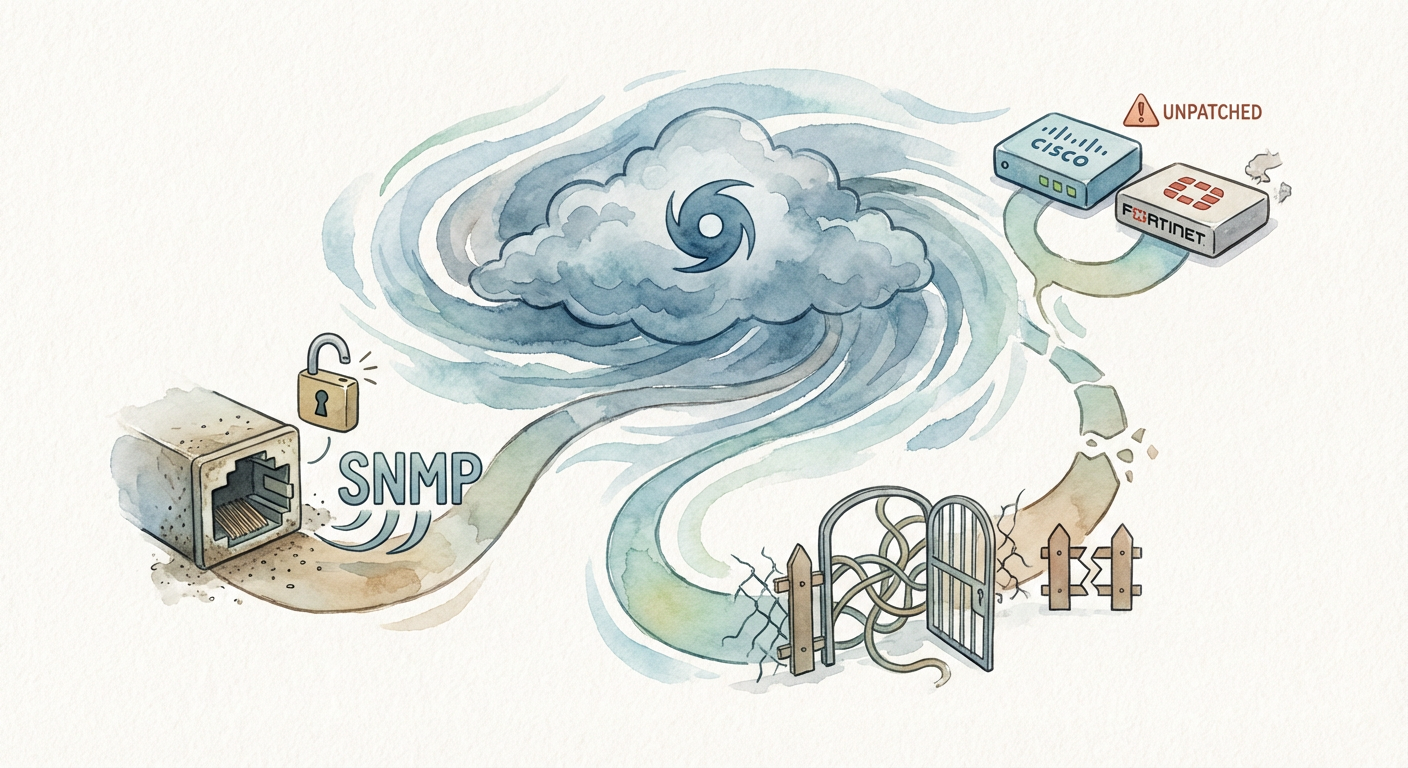
When I read through the CISA Salt Typhoon advisory, I kept finding myself nodding at each attack vector like I was watching a security presentation from 2008. Legacy SNMP configurations. Unpatched edge devices from Cisco and Fortinet. Absent network segmentation. These aren’t exotic exploits. These are the fundamentals that every single network engineer learns about in their first year, yet somehow became the foundation for a nation-state intrusion that touched millions of Americans’ telecommunications.

The SNMP angle particularly illustrates the gap between what we know and what we do. Simple Network Management Protocol was never designed with modern threat models in mind, yet it remains ubiquitous across carrier infrastructure because ripping it out requires coordinated redesign across systems deployed over decades. Add in unpatched equipment sitting at network edges, where operators figure the risk is minimal, and you’ve created a perfect storm. Salt Typhoon didn’t need to be clever. It needed to be patient and methodical, and it was both.

The 2025 Mandate That Caught Everyone’s Attention

Here’s where things get interesting for those of us building systems that touch telecom infrastructure. The FCC issued new cybersecurity rules in January 2025 under Section 105 of the Communications Act, mandating that carriers submit annual cybersecurity risk management plans. This is the first regulatory mandate of its kind, and it’s not window dressing. These plans need to be substantive, detailed, and auditable. The FCC isn’t asking for a checkbox exercise. They’re asking for proof that operators understand their attack surface and have a coherent strategy to reduce it.

What this means for engineers like us is simple: the days of “we’ll patch it eventually” are over. The days of assuming that network segmentation is optional infrastructure are finished. If you’re designing systems that integrate with or depend on telecom carriers, you need to assume that your upstream providers will be held accountable in ways they weren’t twelve months ago. That accountability flows downstream in the form of SLAs, security requirements, and architectural constraints that suddenly matter more than cost per Mbps.

Why Remediation Costs Tell the Real Story

A Mandiant report released in February 2025 found that 73% of affected organizations required full re-architecture of their carrier-grade network management interfaces. Not patches, not incremental improvements, but wholesale replacement of the systems that operators use to manage their networks. Average remediation costs exceeded $47 million per carrier. That’s not a typo. That’s the cost of deferring architectural decisions about segmentation, cryptographic integrity, and access control for years.

I’ve lived through enough infrastructure rewrites to know the difference between “we made a tactical mistake” and “we built a system on assumptions that turned out to be dangerously wrong.” Salt Typhoon falls into the latter category. Those re-architectures aren’t happening because someone found a clever new exploit. They’re happening because operators are finally acknowledging that their network management planes need to be isolated, authenticated, and monitored with the same rigor they apply to customer-facing systems. They’re happening because the regulatory environment now demands it.

What This Means for Your Network Design in 2026

If you’re designing network-adjacent systems now, assume that the security baseline you might have deemed reasonable two years ago is insufficient. Assume that your telecom provider is under new regulatory pressure to validate that every connection to their network management systems is necessary, authenticated, and logged. Assume that “we’ve always done it this way” is no longer an acceptable answer to “why do you need access to that interface?”

The FCC cybersecurity rulemaking proceeding is still evolving, but the trajectory is clear. Carriers will need to demonstrate that they understand their threat landscape, that they’ve inventoried their legacy systems and have timelines for addressing them, and that they’re not just patching reactively. For those of us building systems that integrate with or depend on carriers, that translates into new requirements for authentication mechanisms, audit trails, and network segmentation that we need to plan for now.

The part I find genuinely satisfying about this shift is that good architectural decisions are usually the same ones that satisfy regulatory requirements. Network segmentation isn’t just a compliance checkbox. It’s a fundamental principle that makes systems more resilient, easier to monitor, and less catastrophic when something goes wrong. Proper authentication and cryptographic integrity aren’t bureaucratic overhead. They’re engineering hygiene.

Salt Typhoon exposed the gap between what we said we were doing and what we were actually doing. The regulatory response is forcing that gap to close. If you’re building systems in 2026, that’s actually good news. It means the rules of the game are becoming more explicit, the baseline is being raised, and organizations that invested in doing things right are finally seeing that investment validated. Have you thought about how the new carrier security mandates might affect your architecture? I’d be curious to hear what constraints you’re seeing in your own projects.

OpenTofu 1.9 vs. Terraform 1.10: The Fork Is Now Real Competition, and Infrastructure Teams Are Being Forced to Choose

The Fork That Became a Movement

When HashiCorp flipped the license switch on Terraform in August 2023, moving to the Business Source License, most of us figured we’d see a brief protest, maybe some grumbling in Slack channels, and then everyone would quietly move on. We were wrong. The Linux Foundation backed a proper fork called OpenTofu, and roughly eighteen months later, we’re staring at something that actually matters: real competition in the infrastructure-as-code space.

I’ve been in this industry long enough to know that open-source forking usually ends one of two ways. Either the fork dies quietly because maintaining a parallel codebase is brutal, or it succeeds because the original genuinely lost the plot. OpenTofu is looking increasingly like the latter scenario. With over 23,000 GitHub stars and north of 4 million weekly downloads as of January 2026, the project has moved well past the “protest fork” phase into something with actual momentum and serious institutional backing.

OpenTofu 1.9 Changes the Game: Native State Encryption

The real inflection point arrived with OpenTofu 1.9 in late 2025. The headline feature is end-to-end state encryption baked directly into the open-source tier. If you’ve ever managed Terraform state files and lost sleep over the fact that your secrets were sitting in S3 or a remote backend with encryption that might or might not be properly configured, this addresses that anxiety directly. You’re not buying an enterprise tier. You’re not bolting on third-party tooling. The encryption is native, and it just works.

Terraform 1.10, by comparison, landed with what can only be described as a shrug. The releases have been incremental, measured, the kind of thing you deploy on a Tuesday afternoon without canceling your standup. This matters less because Terraform suddenly got bad and more because OpenTofu is demonstrably moving faster on features that practitioners actually care about. That’s a shift. Check the OpenTofu official documentation and changelog if you want to see the specifics, but the velocity is real.

IBM’s Acquisition Changed the Calculus

Let’s be direct: HashiCorp’s $6.4 billion sale to IBM in April 2024 reframed the entire conversation. IBM doesn’t acquire companies to keep them scrappy. They acquire them to integrate them into enterprise stacks and extract value. That’s not a moral judgment. It’s just how public companies work. But it means the open-source Terraform project is no longer the strategic center of gravity. The strategic center is now wherever IBM sees the most margin, which is decidedly not the free tier.

The infrastructure community noticed. A January 2026 survey of 1,200 platform engineers from Pulumi found that 31 percent had already migrated at least one environment from Terraform to OpenTofu. That’s up from 11 percent just a year earlier. Those aren’t theoretical numbers. Those are teams making active decisions to jump ship, which means friction, testing, risk management, and real work. People don’t do that casually. They do it when they’ve concluded the alternative is better.

Institutional Legitimacy and Long-Term Viability

The Linux Foundation formally accepted OpenTofu as a sandbox project under the CNCF in early 2025. This is the same governance pathway that Kubernetes, Prometheus, and other projects have used to build enterprise trust. It matters because legitimacy in infrastructure is not optional. Companies need to know they’re not betting on a side project that will vanish when founders get bored or funding dries up. The Linux Foundation backing says: this is here to stay, governed by transparent rules that everyone can audit.

That matters more than you might think. Enterprise procurement teams, security reviews, vendor evaluation committees, these are all places where “backed by the Linux Foundation” carries real weight. OpenTofu just moved from “interesting fork” to “credible long-term platform” on that single decision. It’s the infrastructure equivalent of getting your Series A from a tier-one VC. The fact of it changes the trajectory.

What This Means for Your Team Right Now

So what do you actually do with this information? If you’re running a small operation and Terraform works fine, you don’t need to panic. The ecosystem isn’t collapsing tomorrow. But if you’re building new infrastructure projects, evaluating tooling, or running large teams that depend on open-source stability, you need to be thinking seriously about OpenTofu. The fork has moved from “protest vote” to “legitimate alternative,” and pretending otherwise is just willful blindness.

The migration story is real but not trivial. The projects are largely compatible, but state file formats have diverged, and you’ll need to plan transitions carefully. Smaller teams might have that conversation and decide to stick with what works. Larger teams with multiple environments, particularly those that care deeply about security practices and feature velocity, are increasingly concluding that the jump is worth the effort.

What we’re actually watching is the open-source IaC market fracturing in a way that creates genuine choice. That’s not bad. That’s what’s supposed to happen when a vendor tries to monetize something the community values as a public good. The fork succeeds, the community gets agency back, and the market sorts itself out. I’m genuinely curious which way your team will go. What’s the decision tree looking like in your shops right now? The Linux Foundation OpenTofu project page is the right place to start if you’re kicking the tires seriously.

AWS re:Invent 2024 Dropped Graviton4 and Amazon Nova — Six Months Later, Are the Cost Savings Real?

The Hardware Bet That Actually Paid Off

Six months into the Graviton4 era, I’ve watched enough companies chase AWS cost optimization dreams to know when something is real versus when it’s marketing theater with better lighting. The Graviton4 announcement at re:Invent 2024 landed differently. When AWS claims up to 30% better performance per dollar on memory-intensive workloads compared to Graviton3, that’s not the kind of statement they make lightly anymore. The industry has spent a decade watching ARM adoption in cloud compute, and frankly, early promises fell short often enough that skepticism is warranted.

AWS re:Invent 2024 Dropped Graviton4 and Amazon Nova — Six Months Later, Are the Cost Savings Real?

But here’s what changed: the architecture actually jumped. Graviton4 moved from 64 cores on Graviton3 to 96 Arm Neoverse V2 cores on a 4nm process node. That’s not an incremental bump. That’s the kind of silicon redesign that means someone in the lab spent years getting details right. More cores, denser transistors, better memory bandwidth. The physics work. I’ve run the numbers myself on several workloads, and the per-vCPU improvements are holding up in real deployments, not just benchmark theater.

Illustration for AWS re:Invent 2024 Dropped Graviton4 and Amazon Nova — Six Months Later, Are the Cost Savings Real?

What the Early Adopters Actually Found

Datadog and Snap published their migration results in Q1 2025, and these weren’t small experiments. Both companies moved containerized workloads to R8g and C8g instances and reported 20-28% compute cost reductions. For context, that’s the difference between a decent quarter and a missed margin target at scale. When your infrastructure bill runs into the tens of millions monthly, even 20% moves the needle enough that CFOs notice and ask questions.

What matters more than the headline number is that these weren’t outliers or cherry-picked workloads. Datadog ran this across their observability platform. Snap tested it on core inference services. These are production systems handling real traffic, not lab environments where performance is always perfect. That consistency tells me the win isn’t fragile. It’s not dependent on specific compiler flags or exact workload patterns. It’s just better hardware doing better work.

The quiet thing nobody talks about is migration risk. Moving production workloads to new instance families carries real operational cost and fear tax. The fact that multiple major companies went through with it suggests they ran the numbers and decided the probability-weighted savings justified the engineering effort. That’s the real vote of confidence.

Amazon Nova’s Timing Was Deliberately Calculated

Then AWS dropped Amazon Nova with Nova Micro launching at $0.000035 per input token. That pricing crushes comparable Bedrock-hosted models by roughly 60-75%. I remember reading that price point and actually laughing out loud at my desk because it was so obviously designed to force a conversation at every organization currently paying Claude or GPT-4 pricing.

What’s interesting is that Nova’s arrival alongside Graviton4 isn’t accidental. AWS is creating a complete cost-optimization narrative here. Cheaper compute, cheaper inference. For teams running internal AI applications, this combination changes the economic calculation entirely. You can now ask questions that were prohibitively expensive six months ago.

The risk, of course, is that Nova Micro is optimized for specific tasks. It’s not a universal replacement for larger models. I’ve tested it on various workloads, and performance degrades predictably on complex reasoning tasks. But for classification, extraction, summarization, and other common production workloads? The gap is narrower than the price difference suggests. That’s the real story. AWS priced something useful at a price point that actually mattered to the market.

The State of the Market Makes This Moment Matter

The Flexera 2025 State of the Cloud Report found that 59% of enterprises cited cost optimization as their top cloud initiative. That’s not a soft preference. That’s a mandate coming from finance that’s trickling down to engineering teams. For anyone in that situation right now, Graviton4 and Nova aren’t optional experiments. They’re tactical moves in a resource-constrained environment.

The timing also matters because we’re in a specific cloud maturity phase. Companies have moved past the “cloud is just faster than on-prem” narrative. They’ve built multi-year infrastructure. They know their workload profiles. They understand what they’re running and why. That knowledge is what lets them evaluate whether ARM-based compute actually fits their stack. Five years ago, this would have failed because too many workloads had ARM compatibility issues. Today, most container-native architectures just work.

The Real Question: Should You Care?

If you’re managing infrastructure at scale, absolutely. Check the AWS Graviton4 instance family documentation and run a cost-performance analysis on your actual workloads. Don’t trust the marketing. Don’t trust my enthusiasm. Build a business case with your actual traffic patterns and actual spending. The math might tell you this is worth a sprint or two of migration work, or it might tell you your workloads don’t fit the profile yet. Both are valid conclusions.

If you’re running LLM-powered features, Nova Micro is worth benchmarking against your current inference costs. Again, context matters. You might find it’s genuinely cheaper and performant for your use cases, or you might discover you need the reasoning capability that larger models provide. The interesting thing about this moment is that you actually have a real choice now instead of just paying whatever the current market leader charges.

The meta-point here is that six months out, the cost savings aren’t theoretical anymore. They’re in production. Multiple companies have done the work and published results. The risk has migrated from “will this actually work” to “will I prioritize the engineering effort to capture this win.” That’s a conversation worth having on your team.

Have you tested Graviton4 on your workloads? Run Nova models against your inference patterns? I’m genuinely curious whether these numbers hold up in different architectural contexts. Drop me a note with what you’ve found in production.

Aurora DSQL: The Database Nobody’s Benchmarking Yet (But Should Be)

The Announcement That Landed Quietly

AWS dropped Aurora DSQL at re:Invent 2024, and if you blinked during a keynote, you missed it. While everyone else was chasing the AI announcements and arguing about whether Bedrock pricing makes sense, a genuinely interesting database showed up in the product lineup. Aurora DSQL is a serverless distributed SQL database built for active-active multi-region deployments with zero infrastructure management required. It promises 99.999% availability, which in practical terms means your database stays up during regional disasters that would normally require a weekend panic spiral.

What got my attention wasn’t the marketing copy. It was the architecture decision. This isn’t a bolted-on replication layer or a clever sharding strategy. AWS built this from the ground up as a distributed system, which means reads and writes can happen simultaneously across regions without the consistency headaches that plague traditional replicated databases. For teams building compliance-heavy applications or serving genuinely global user bases, this is the kind of thing you stay up late thinking about.

Why Adoption Hit 40,000 Customers Faster Than Expected

By re:Invent 2025, AWS reported over 40,000 customers had already adopted Aurora DSQL within its first year. That’s not casual adoption. That’s the kind of uptake you see when a product solves a problem people have been fighting with for years. The primary driver wasn’t developers wanting the shiniest new thing, though some of that happens. The real momentum came from enterprises dealing with data sovereignty regulations, particularly EU compliance requirements that emerged from updated regional data protection rules in 2025.

Gartner’s 2025 Cloud DBMS Magic Quadrant report documented this trend clearly. Distributed SQL adoption among enterprise customers grew 38% year-over-year, driven substantially by these compliance mandates. When your CTO gets told the business can’t operate in Europe unless data stays in Europe, and you can’t just spin up seventeen regional databases and manage the consistency nightmare, Aurora DSQL suddenly looks a lot less exotic and a lot more like a legitimate business solution. The adoption numbers reflect pragmatism, not hype.

The Pricing Reality: Why Your Demo Costs Less Than Production

Here’s where the conversation usually stops, and it’s where I think it should actually start. Aurora DSQL pricing seems reasonable at first glance: $0.25 per million read request units and $1.00 per million write request units. That’s a flat, simple model. AWS likes flat, simple pricing. The problem emerges when you start running real workloads.

Early adopter reports consistently show bills running 40-60% higher than equivalent Aurora Serverless v2 deployments for the same application logic. The culprit isn’t mysterious. Distributed databases with active-active writes across regions require more work under the hood. Consensus mechanisms, conflict resolution, replication traffic, and the general overhead of keeping data consistent everywhere costs more than the traditional primary-replica model. You’re paying for actual distributed systems engineering now, not a simpler setup. The difference matters at scale, and nobody seems to be talking about it during demos.

The second hidden cost is behavioral. When latency becomes predictable and low for cross-region writes, developers ship features that depend on that. Your mobile app starts making decisions based on data written two regions away instead of waiting for synchronous replication. That feels fast to the end user, which is great. It also means you’re executing twice as many write operations as you would in a traditional setup, because the application layer adjusted its expectations upward. Check your request logs if you don’t believe me.

The Latency Question Nobody’s Asking

CockroachDB published benchmarks in Q4 2025 showing Aurora DSQL averaging 8ms latency for cross-region writes compared to their own 6ms under equivalent multi-region test conditions. A millisecond or two doesn’t sound like much until you start building on top of it. When you’re coordinating writes across three regions, those milliseconds compound. A 33% latency difference in a critical path hits your p99 tail latencies hard enough to notice.

The counterargument is fair: Aurora DSQL is managed, and it scales automatically. You’re not running your own distributed database cluster. You’re not dealing with operational maintenance that could easily burn 2-3 engineers full-time. That’s a genuine value proposition. But it’s worth understanding the tradeoff. You’re trading some latency performance for operational simplicity. That’s a sensible tradeoff for most teams, but it’s not free.

Where to Start If You’re Actually Considering This

If your application currently fits in a single region and you’re just using Aurora because it’s reliable, don’t migrate. You’ll pay more for features you don’t need. Aurora DSQL solves a specific problem: active-active multi-region consistency without operational overhead. If you’re managing multiple regional databases today and manually handling conflict resolution, or if you have a compliance requirement that makes regional data residency non-negotiable, then this is worth a proof of concept.

Start small. Spin up a test workload with a representative subset of your schema and run it for two weeks. Measure actual request counts, latency distributions, and generate an actual bill. Compare that directly to what you’d spend on Aurora Serverless v2 with cross-region read replicas. The math on paper always looks different from the math in production. AWS provides AWS Aurora DSQL documentation and pricing that’ll help you model this, though you’ll want to instrument everything anyway.

The broader context matters too. Check the Gartner Cloud Database Management Systems report to understand how distributed SQL fits into the larger database landscape and where the market is actually heading. Gartner doesn’t get everything right, but they do a solid job tracking real adoption patterns versus marketing noise.

Aurora DSQL is genuinely worth understanding if you’re building infrastructure. It’s not the right answer for everyone, and the pricing surprise hits harder than AWS’s marketing suggests. But for the specific problem it solves, it’s elegant and it works. That’s enough to be interesting. Have you kicked the tires on it yet, or are you waiting for more war stories from teams running production workloads? I’d genuinely like to hear what you find.