Your Mental Model Is Probably Wrong
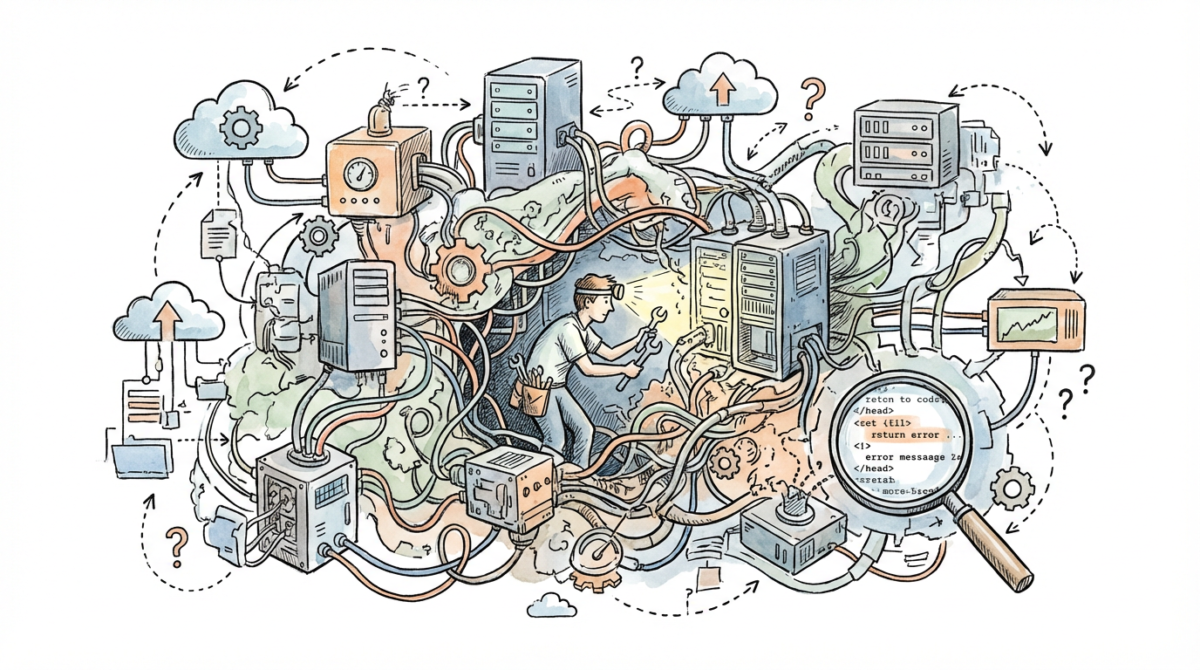
After fifteen years of chasing ghosts through microservice architectures, I’ve come to accept a fundamental truth: distributed systems debugging is less like detective work and more like archeology. You’re not following a clean trail of breadcrumbs. You’re excavating fragments of evidence from different geological eras, trying to reconstruct what happened to a civilization that may have never existed in the first place.
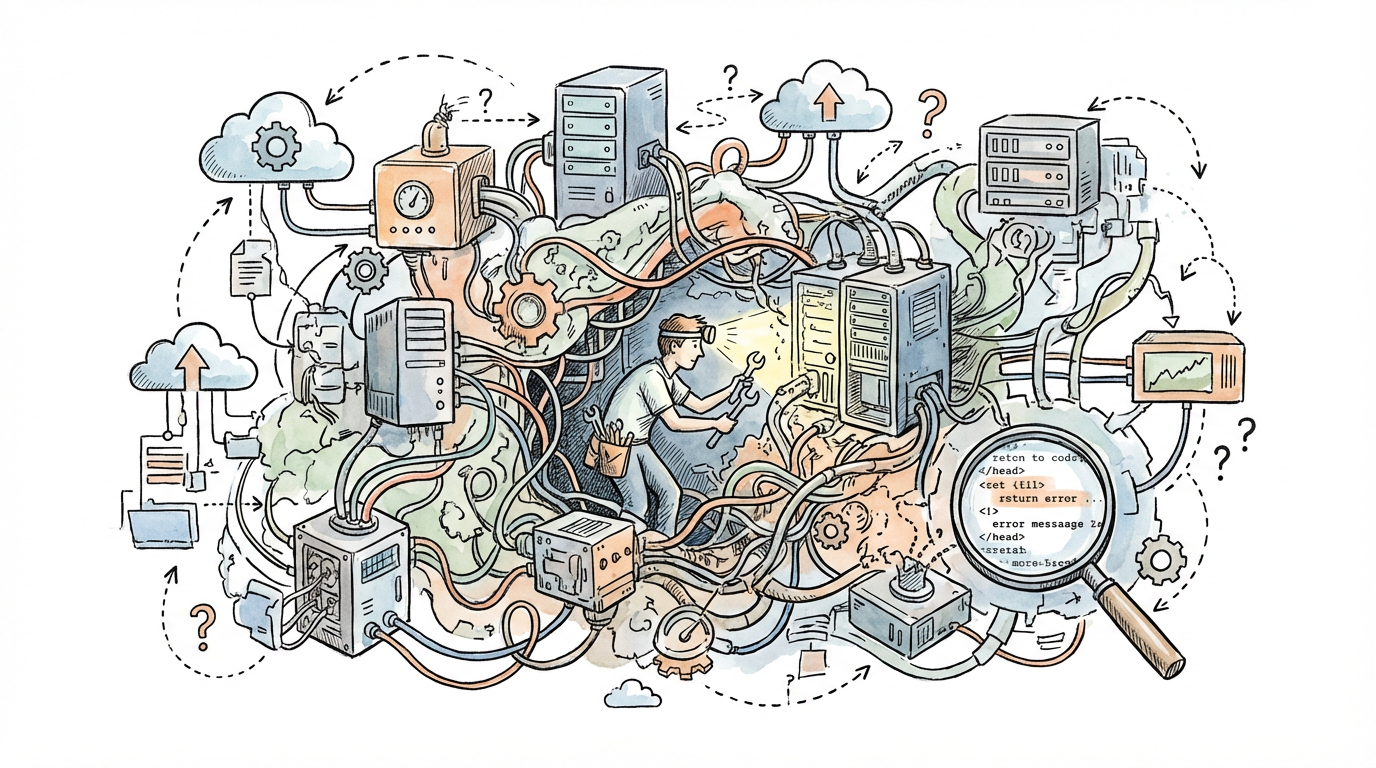
The first mistake most engineers make is assuming causality works the way it does in monolithic applications. You know the drill: exception happens, stack trace points to line 47, fix line 47, deploy, problem solved. But in distributed systems? Your stack trace points to a perfectly innocent HTTP client call that worked fine. The real culprit? A connection pool that got exhausted in a completely different service and started rejecting requests 200 milliseconds earlier. Good luck finding that in your dashboard.
This brings me to the first law of distributed debugging: correlation does not imply causation, but the absence of correlation definitely means you’re looking in the wrong place. That spike in latency that coincides with your deployment? It’s probably not your deployment. It’s probably the batch job that runs every Tuesday at 2 PM and just happened to align with your release window. Again.

Observability Theater vs. Actual Understanding
We’ve collectively spent millions of dollars on observability tooling, and somehow we’re still debugging with printf statements and prayer. The problem isn’t the tools. The problem is that we’ve mistaken data collection for understanding. Your Grafana dashboard with 47 metrics and three different shades of red looks impressive, but it’s also useless when you’re trying to figure out why user 12345’s checkout request failed exactly once at 3:17 AM.
Real observability means designing your system to tell you a story, not just dump data. This means structured logging with correlation IDs that actually propagate (looking at you, service mesh sidecars that strip headers). It means metrics that measure business outcomes, not just technical ones. It means distributed tracing that doesn’t mysteriously stop working when traffic gets heavy and you actually need it.
Here’s a controversial take: if you can’t debug your system with just the logs, your system is poorly designed. I don’t care how sophisticated your tracing setup is. Logs should tell a coherent story about what your application was trying to do and why it failed. If your logs look like alphabet soup, fix that first before you add another monitoring tool to the stack.
The Time Dimension Problem
Time is weird in distributed systems. Not quantum physics weird, but weird enough to make you question your sanity at 3 AM. Your services run on different machines with clocks that drift. Your messages travel through networks with variable latency. Your databases replicate asynchronously. And you’re trying to piece together what happened when based on timestamps that might be off by seconds or minutes.
The second law of distributed debugging: never trust a timestamp, but always record one anyway. Clock skew will bite you. Network delays will confuse you. But having imperfect timing information is still better than having no timing information at all. Just remember to include sequence numbers, request IDs, and logical clocks in your instrumentation. Lamport timestamps might seem like academic overkill until you’re trying to order events across a dozen services and your wall clock timestamps are useless.
This is why I’m a huge fan of structured events over traditional metrics for debugging. A counter that says “payment_failures: 12” tells you something bad happened. An event that says “payment failed for user 12345 at step ‘bank_authorization’ with error ‘insufficient_funds’ after 2.3 seconds” tells you exactly what happened and gives you a starting point for investigation.
Failure Modes You Didn’t Know Existed
Distributed systems fail in creative ways that would make a chaos engineer weep with joy. You’ll encounter failure modes that don’t exist in textbooks. Like the time our payment system started failing because a leap second caused our rate limiter to think every request was from the future. Or when our user service went down because someone deployed a new feature flag configuration that accidentally enabled a feature for 100% of traffic instead of 1%.
The third law of distributed debugging: the most interesting failures happen at the boundaries between systems. Your service works fine in isolation. The downstream service works fine in isolation. But put them together under load and suddenly you discover that your circuit breaker implementation doesn’t play nice with their retry logic, creating a feedback loop that takes down half your infrastructure.
This is why I always build debugging hooks into production systems from day one. Not just health checks and metrics endpoints, but actual debugging capabilities. Give me an endpoint that can show me the current state of all active requests. Let me query the system for all operations related to a specific user ID or correlation ID. Make it possible to trace a request’s journey through the system without SSH-ing into production boxes and grepping through log files.
Building Systems That Don’t Hate You Back
The best debugging experience comes from systems designed to be debugged. This means building in visibility from the start, not adding it on later. It means choosing consistency models that make sense for your debugging needs, not just your performance requirements. It means designing your APIs and data models to be introspectable.
Start with the fundamentals: unique request IDs that propagate everywhere, structured logging with consistent field names, and error messages that include enough context to be actionable. Then move on to the fancy stuff: distributed tracing, real-time system state inspection, and automated root cause analysis. But don’t skip the fundamentals. They’ll save you more time than any fancy APM tool ever will.
Most importantly, remember that debugging is a social activity as much as a technical one. The best debugging sessions happen when you can quickly pull in the person who wrote the code, understands the business logic, or deployed the change. Design your systems and your team processes to make this collaboration easy.
I’d love to hear about your own distributed debugging war stories. What’s the weirdest failure mode you’ve encountered? What debugging techniques have saved your sanity? Drop me a line and let’s commiserate about the beautiful complexity we’ve chosen to work with.
